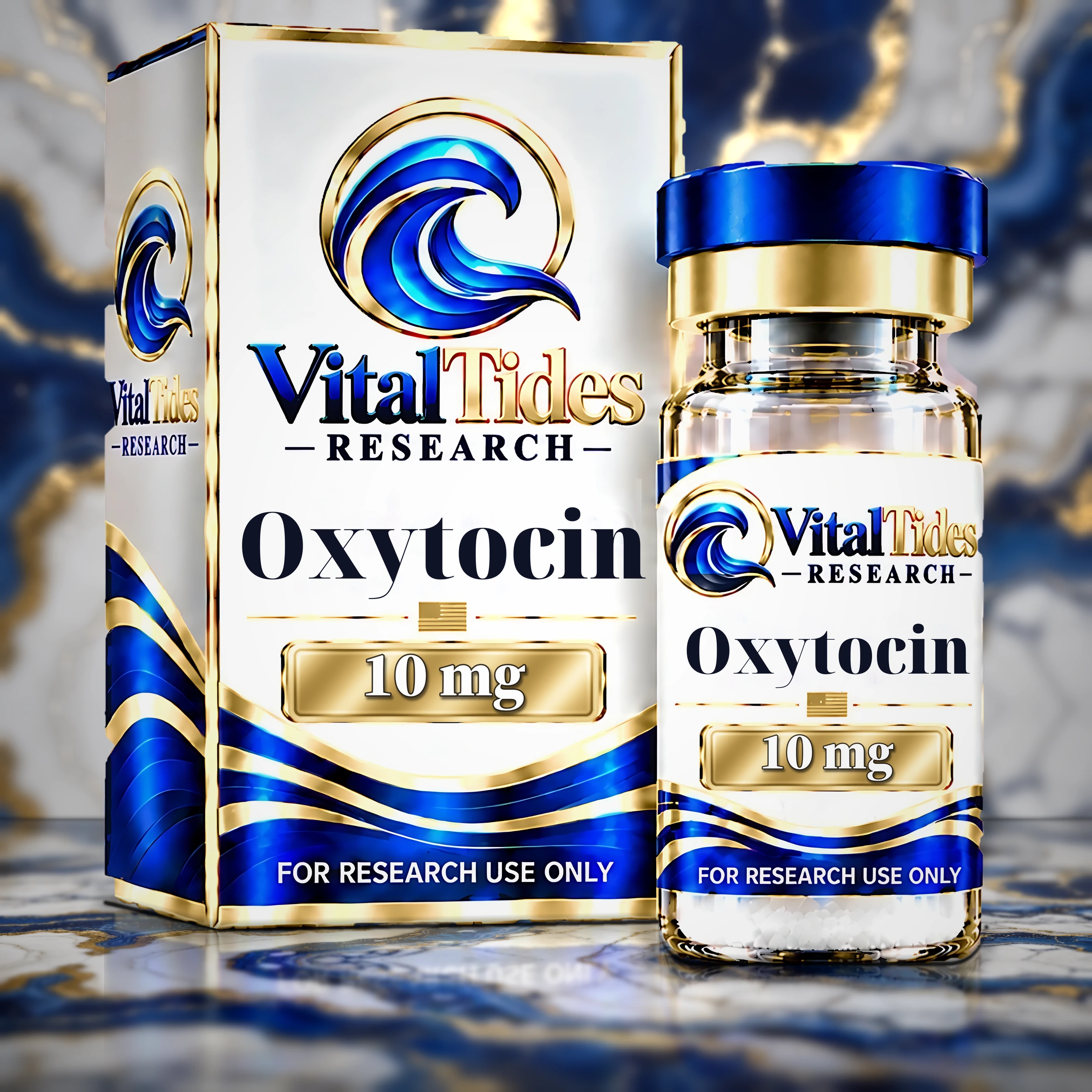
OXYTOCIN
$45.00
1000 in stock
A disulfide-bridged nonapeptide hormone studied in smooth muscle, receptor pharmacology and central nervous system behavioural models. Avoid reducing agents, which inactivate it.
Description
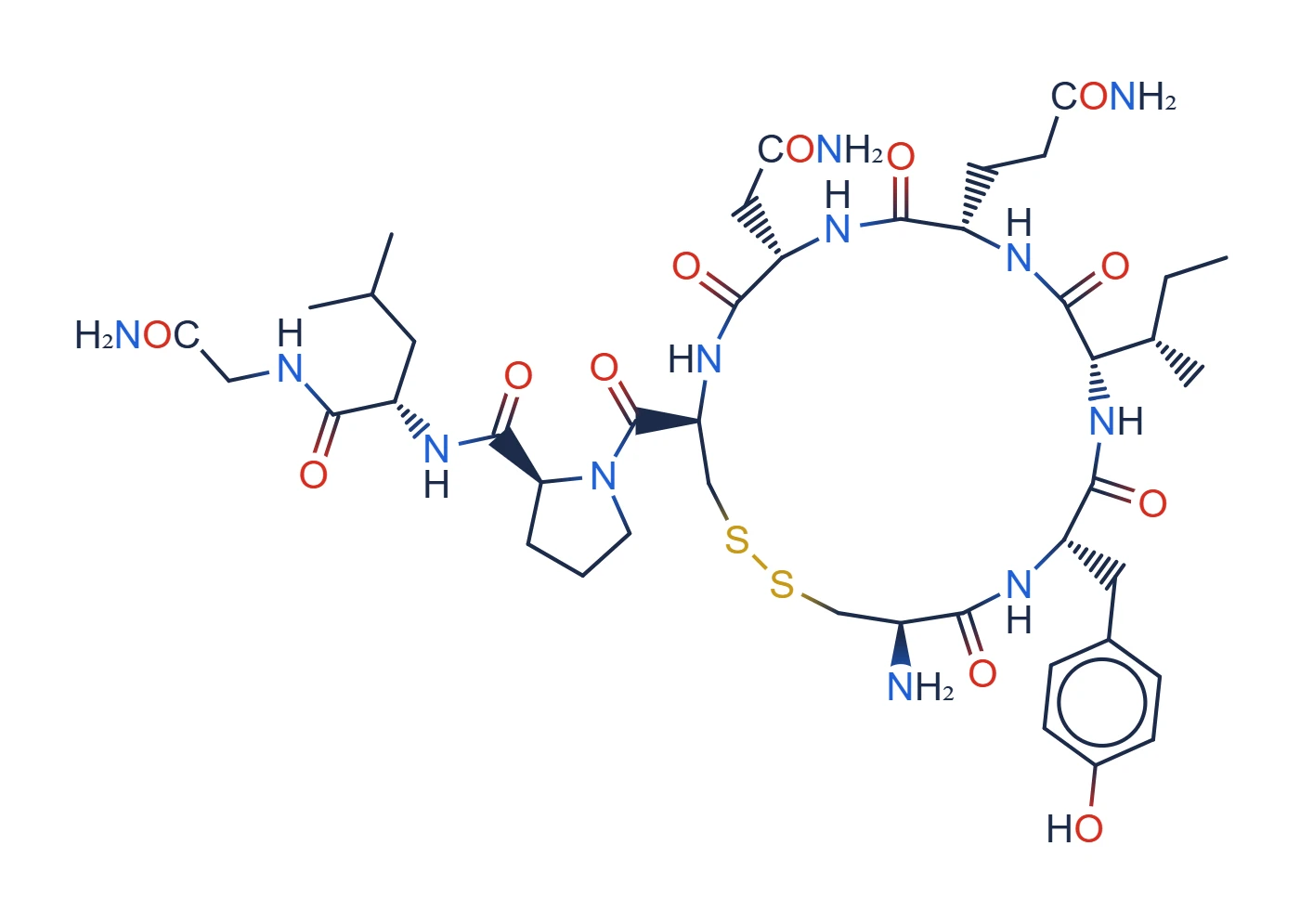
Oxytocin is a nine-amino-acid peptide with the sequence Cys-Tyr-Ile-Gln-Asn-Cys-Pro-Leu-Gly-NH₂ and a molecular weight of 1007.19 g/mol. It is one of the earliest peptide hormones to be chemically characterised and synthesised, work that was recognised with a Nobel Prize in Chemistry in 1955.
Structure
Oxytocin is a cyclic peptide. A disulfide bridge links the cysteine residues at positions one and six, closing the first six residues into a ring and leaving a three-residue tail, Pro-Leu-Gly, extending from it with an amidated C-terminus.
That ring is not decorative. The disulfide-constrained conformation is required for receptor binding, and reduction of the bond destroys activity. This has a direct practical consequence: reducing agents such as dithiothreitol or beta-mercaptoethanol will inactivate the peptide, and buffers containing them should be avoided.
Oxytocin differs from vasopressin, the other nonapeptide of this family, at only two of nine positions. That close similarity underlies the cross-reactivity at each other’s receptors reported in the pharmacology literature, and is worth accounting for in experimental design.
Research background
The literature here is older and larger than for most compounds in this catalogue, spanning more than seventy years.
The foundational area concerns smooth muscle, particularly uterine tissue, which is the activity that originally defined the hormone and gave it its name.
A second area concerns receptor pharmacology, with extensive in vitro characterisation of the oxytocin receptor, a class A G-protein-coupled receptor, and of cross-reactivity with vasopressin receptor subtypes.
A third area concerns central nervous system signalling. Published work in animal models has examined oxytocin in relation to social behaviour, pair bonding and anxiety-related paradigms, and this is the area responsible for most recent research attention.
A fourth area concerns autonomic and cardiovascular effects.
The material supplied here is for laboratory research only and is not intended for human or veterinary use.
Storage and handling
Store the lyophilized powder at 36 to 46 °F (2 to 8 °C), desiccated and protected from light. Allow the vial to reach room temperature before opening.
Use 1007.19 g/mol for the free base; acetate forms carry a different mass.
Purity and verification
Each lot is analysed by an independent laboratory, with identity confirmed by mass spectrometry and purity by HPLC. Test scope varies by lot; consult the certificate for the lot you receive.
CYIQNCPLG
Additional information
| Vial Size | 10mg |
|---|---|
| Format |
Related products
-
DIHEXA
Price range: $52.00 through $85.00Quick ViewSelect options This product has multiple variants. The options may be chosen on the product pageDIHEXA
Price range: $52.00 through $85.00
A lipophilic angiotensin IV derivative that binds hepatocyte growth factor and potentiates c-Met signalling, studied in neurite outgrowth and rodent cognitive models.
-
DSIP
Price range: $60.00 through $75.00Quick ViewSelect options This product has multiple variants. The options may be chosen on the product pageDSIP
Price range: $60.00 through $75.00
A nine-amino-acid peptide isolated in the 1970s and named for the sleep context of its discovery. No specific receptor has been definitively characterised.
-
-