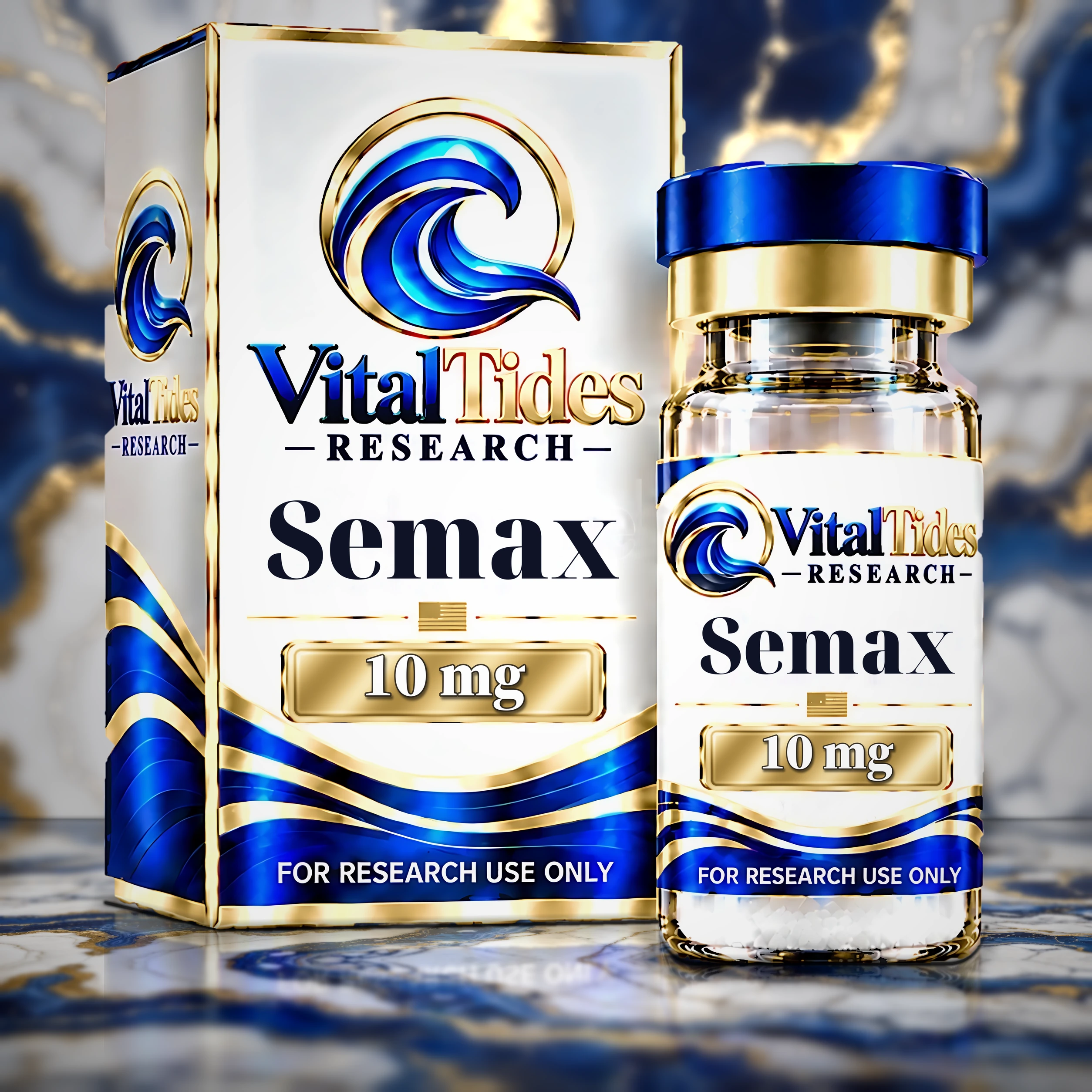
SEMAX
$55.00
1000 in stock
A synthetic heptapeptide built from ACTH(4-7) with a stabilising Pro-Gly-Pro extension, studied in rodent models of BDNF expression, cerebral ischaemia and learning behaviour.
Description
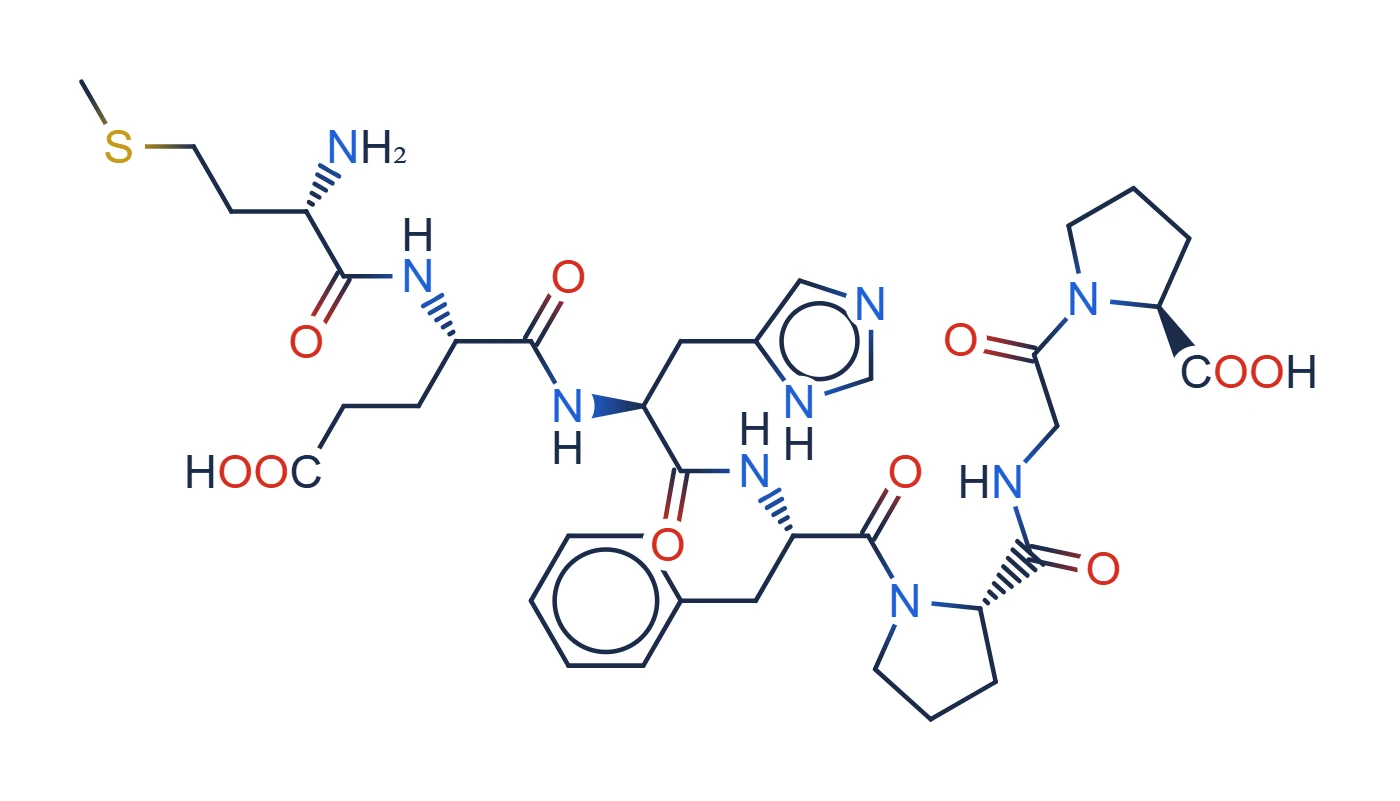
Semax is a synthetic heptapeptide with the sequence Met-Glu-His-Phe-Pro-Gly-Pro, abbreviated MEHFPGP, with a molecular weight of 813.92 g/mol. It was developed in Russia and holds no approval in the United States or Europe.
Structural basis
Semax is built from a fragment of adrenocorticotropic hormone. Specifically it reproduces residues 4 to 7 of ACTH, the sequence Met-Glu-His-Phe, and extends it at the C-terminus with Pro-Gly-Pro.
That extension is the important design element. The ACTH(4-7) fragment alone is degraded rapidly by peptidases. Appending Pro-Gly-Pro confers substantially greater stability, and the same tripeptide extension appears in Selank, which is built on a different parent sequence. Semax and Selank are therefore structural siblings in design approach even though their parent fragments differ.
Critically, the ACTH(4-7) portion retains the behavioural sequence while lacking the corticotropic activity of full-length ACTH. This separation of properties is what made the fragment interesting as a research starting point.
Research background
The literature on Semax is substantial but geographically concentrated. A large proportion originates from Russian institutions and appears in Russian-language journals, which limits its visibility in Western indexing and means independent replication is less extensive than publication volume alone would suggest.
The most frequently cited area concerns brain-derived neurotrophic factor. Published work has reported changes in BDNF and its receptor expression in rodent brain tissue following administration, and this is the mechanism most commonly proposed to account for observations in behavioural models.
A second area concerns cerebral ischaemia models, where the peptide has been studied in rodents.
A third area concerns attention and learning paradigms in animal models, and a fourth concerns effects on the dopaminergic and serotonergic systems.
Much of the published literature on Semax originates from a single geographic region, and no regulatory authority in the United States or European Union has approved it. Researchers should weight the literature with its geographic concentration in mind.
Storage and handling
Store the lyophilized powder at 36 to 46 °F (2 to 8 °C), desiccated and protected from light. Allow the vial to reach room temperature before opening.
Use 813.92 g/mol for molar calculations on the free base. Semax is frequently supplied as an acetate salt, which carries a different mass; if your lot certificate specifies a salt form, calculate against that figure.
Purity and verification
Each lot is analysed by an independent laboratory, with identity confirmed by mass spectrometry and purity by HPLC. Test scope varies by lot; consult the certificate for the lot you receive.
MEHFPGP
Additional information
| Vial Size | 10mg |
|---|---|
| Format |
Related products
-
DSIP
Price range: $60.00 through $75.00Quick ViewSelect options This product has multiple variants. The options may be chosen on the product pageDSIP
Price range: $60.00 through $75.00
A nine-amino-acid peptide isolated in the 1970s and named for the sleep context of its discovery. No specific receptor has been definitively characterised.
-
-

PINEALON
Price range: $45.00 through $75.00Quick ViewSelect options This product has multiple variants. The options may be chosen on the product pagePINEALON
Price range: $45.00 through $75.00
A synthetic tripeptide (Glu-Asp-Arg) from the Khavinson bioregulator programme, studied in cell and rodent models of oxidative stress and neuroprotection.
-