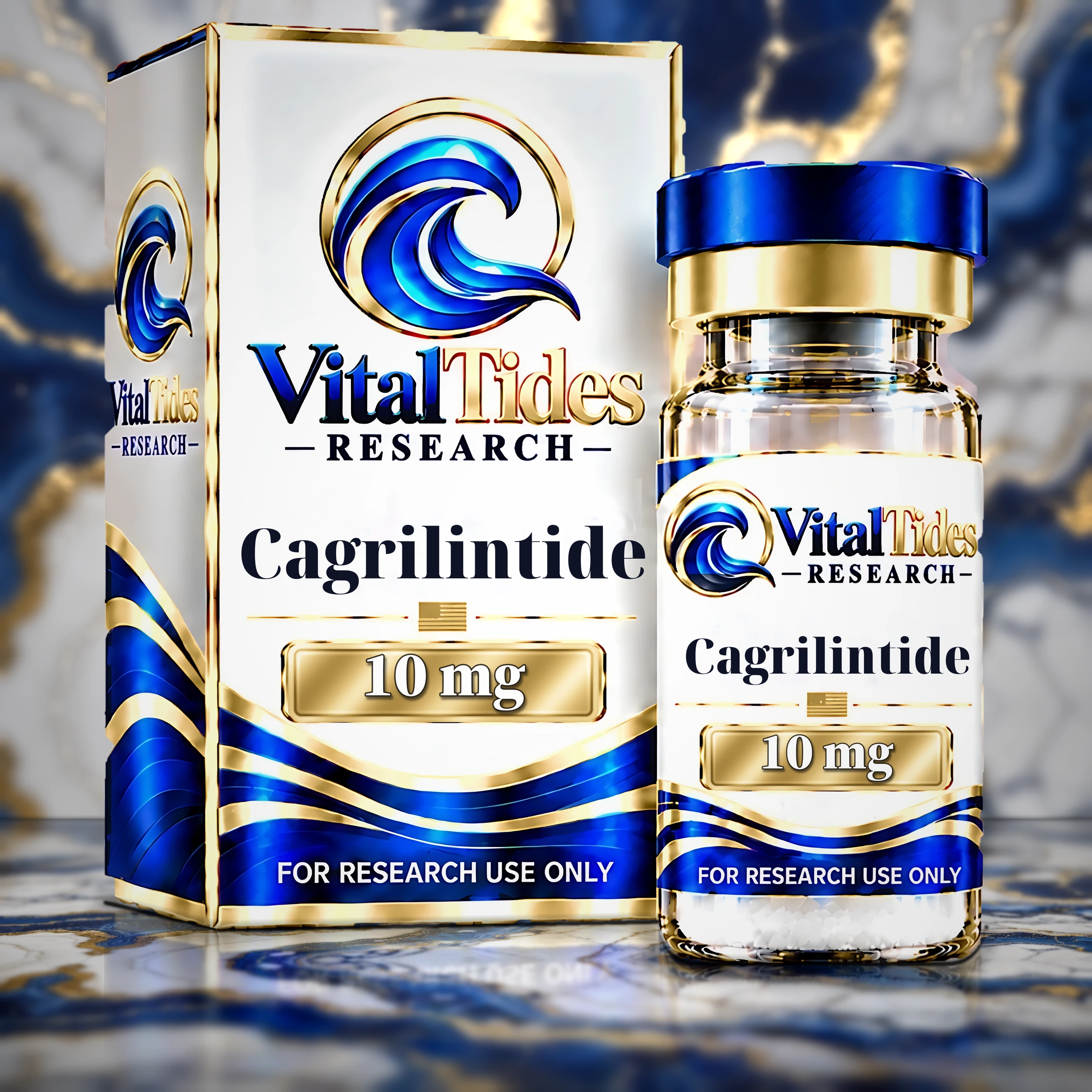
CAGRILINTIDE
$95.00
1000 in stock
A lipidated 37-amino-acid amylin analogue acting at amylin and calcitonin receptors, not incretin receptors. Studied in metabolic research; supplied as lyophilized powder.
Description
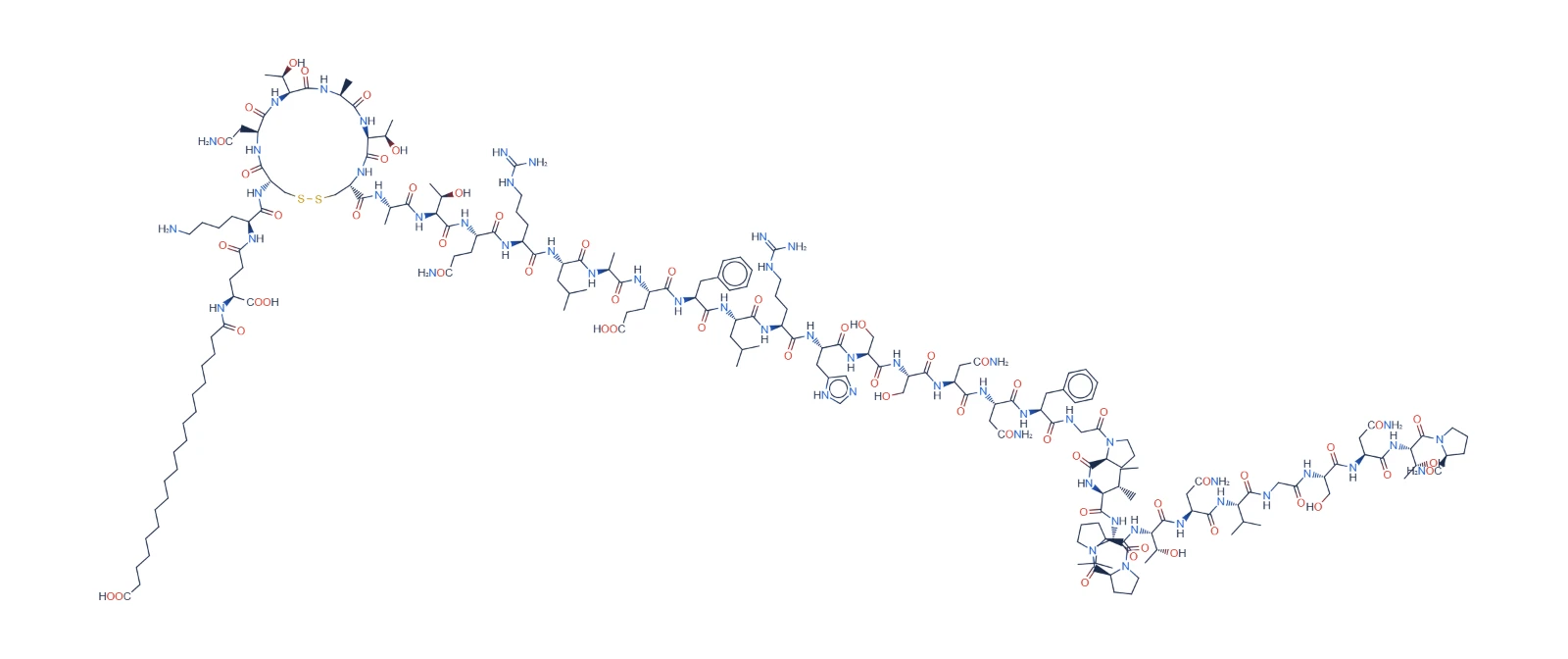
Cagrilintide is a long-acting synthetic analog of the natural hormone amylin, studied in published clinical research in combination with incretin analogues, and is also known as AM833 or NNC0174-0833.
A different mechanism from the incretins
Cagrilintide is frequently displayed alongside GLP-1 and GIP analogues, but it is not one. Amylin is a separate hormone, co-secreted with insulin from pancreatic beta cells, and it signals through amylin receptors and the calcitonin receptor rather than through incretin receptors. Cagrilintide is described as a non-selective agonist across both.
This distinction matters when designing comparative work. A study treating cagrilintide as interchangeable with an incretin analogue is comparing molecules that act on entirely different receptor families, which is also the reason the two classes are investigated in combination rather than as alternatives.
Structure
Native human amylin is itself 37 residues but is notoriously difficult to work with: it aggregates readily and forms amyloid fibrils, which is a significant obstacle both to formulation and to laboratory handling. Cagrilintide is engineered to address this.
The molecule carries an intramolecular disulfide bridge, reflecting the native hormone’s structure, and a C20 diacid lipid conjugation that binds serum albumin reversibly to extend circulating residence time. Substitutions relative to native amylin reduce the aggregation tendency that makes the parent hormone impractical.
Research background
Published work has characterised receptor binding and activation at amylin and calcitonin receptors in cell systems, and examined metabolic parameters in animal models. The compound has been the subject of human clinical investigation, including in combination with incretin analogues, on the rationale that the two receptor families act through independent routes.
No regulatory authority has approved cagrilintide. The material supplied here is for laboratory research only.
Storage and handling
Store the lyophilized powder at 36 to 46 °F (2 to 8 °C), desiccated and protected from light. Allow the vial to reach room temperature before opening.
Use 4409.01 g/mol for molar calculations.
Purity and verification
Each lot is analysed by an independent laboratory, with identity confirmed by mass spectrometry and purity by HPLC. Test scope varies by lot; consult the certificate for the lot you receive.
Additional information
| Vial Size | 10mg |
|---|---|
| Format |
Related products
-

5 AMINO 1MQ
Price range: $60.00 through $100.00Quick ViewSelect options This product has multiple variants. The options may be chosen on the product page5 AMINO 1MQ
Price range: $60.00 through $100.00
A small-molecule NNMT inhibitor supplied as the iodide salt, studied in adipocyte and rodent metabolic models. Not a peptide; salt basis matters for concentration calculations.
-

G2X-TZ
Price range: $85.00 through $235.00Quick ViewSelect options This product has multiple variants. The options may be chosen on the product pageG2X-TZ
Price range: $85.00 through $235.00
A lipidated 39-amino-acid dual agonist acting at the GIP and GLP-1 receptors, built on a GIP-analogue backbone, studied in metabolic research. Supplied as lyophilized powder, identity confirmed by mass spectrometry.
-
-
MOTS-C
Price range: $115.00 through $160.00Quick ViewSelect options This product has multiple variants. The options may be chosen on the product pageMOTS-C
Price range: $115.00 through $160.00
A 16-amino-acid mitochondrial-derived peptide encoded within the 12S rRNA gene, studied in preclinical work on AMPK signalling, glucose handling and metabolic regulation.