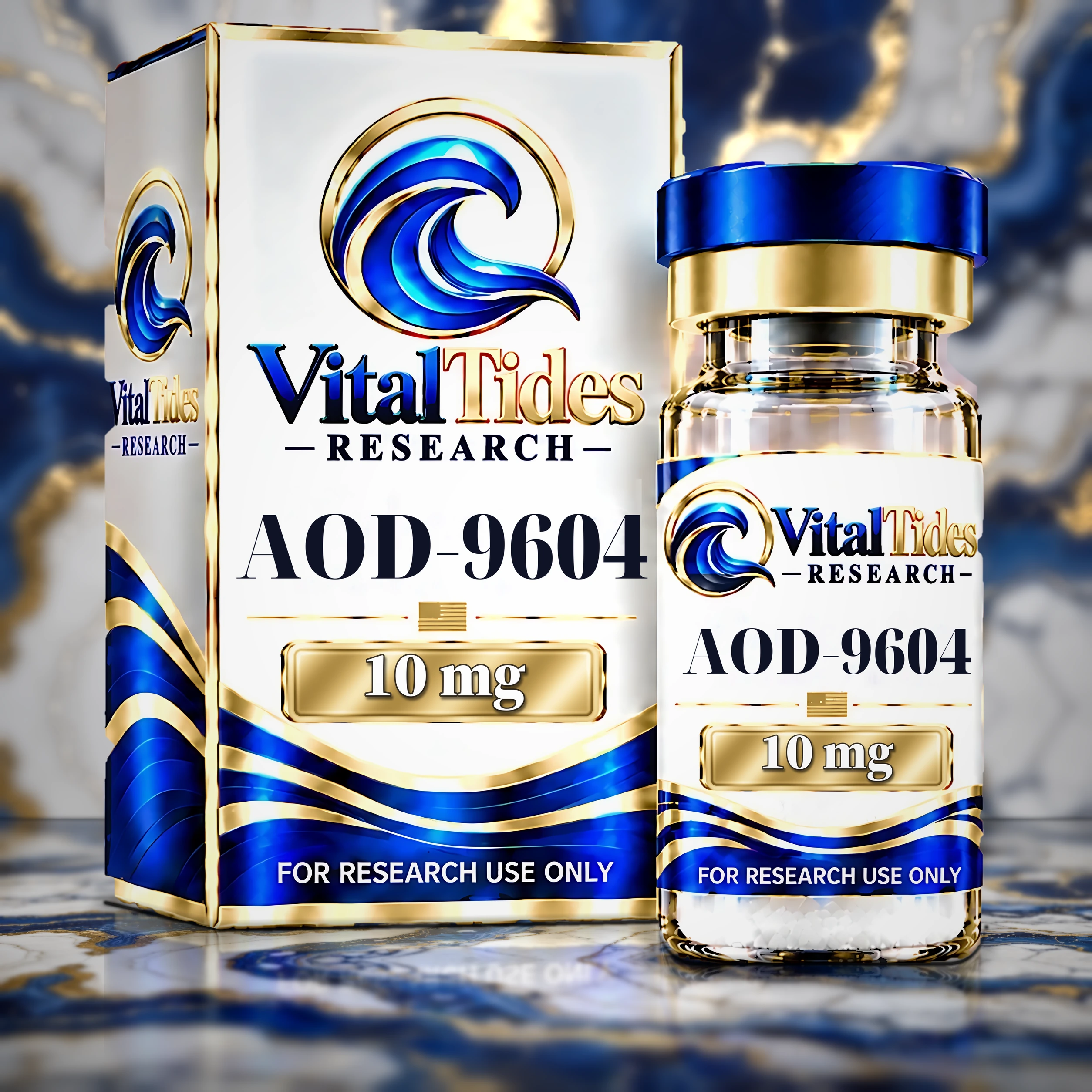
AOD-9604
$70.00
1000 in stock
A 16-amino-acid hGH C-terminal fragment with an added N-terminal tyrosine, studied in adipose and lipid metabolism models. Distinct from unmodified hGH Fragment 176-191.
Description
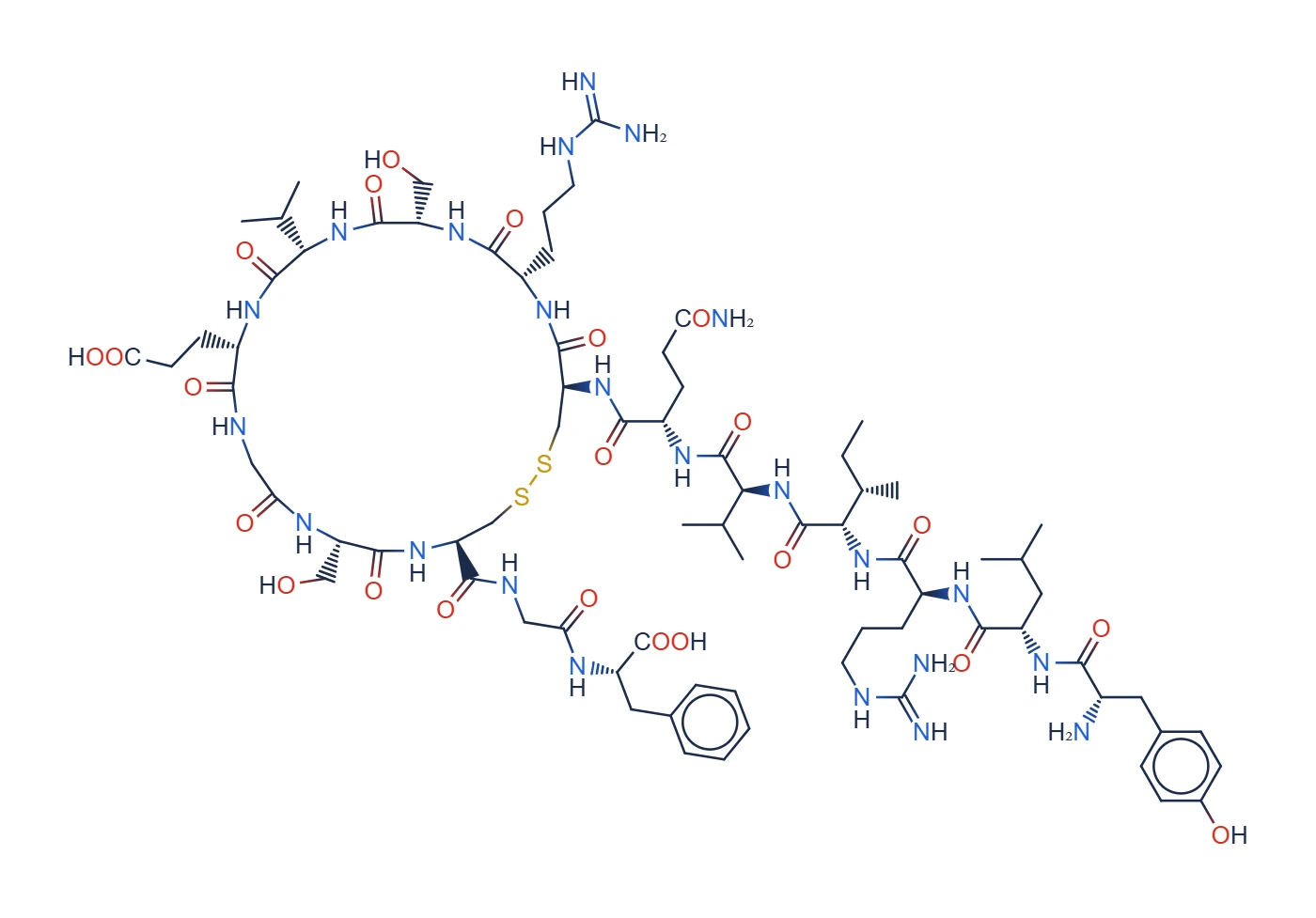
AOD-9604 is a 16-amino-acid peptide with the sequence YLRIVQCRSVEGSCGF and a molecular weight of 1815.10 g/mol. It derives from the C-terminal region of human growth hormone.
What it is, precisely
AOD-9604 corresponds to residues 177 to 191 of human growth hormone with an additional tyrosine added at the N-terminus. It carries a disulfide bridge between the cysteines at positions 7 and 14, reproducing the loop structure that region forms in the parent hormone.
It is not the same as hGH Fragment 176-191. That unmodified fragment lacks the added tyrosine, carries a different registry number, and weighs 1799.10 g/mol, sixteen daltons less. The two are frequently conflated and sometimes substituted for one another in this market, but they are distinct compounds. The distinction also has a research history attached: AOD-9604 is the version that went through human clinical investigation, while the unmodified fragment did not, so literature describing clinical work refers specifically to the tyrosine-extended form.
If you are comparing published results or sourcing from multiple suppliers, confirm the registry number rather than the common name.
Why a fragment
Full-length growth hormone is a 191-residue protein with a broad activity profile, including effects on IGF-1 and glucose handling mediated through receptor binding. The C-terminal region was investigated on the premise that a short fragment might retain the lipolytic behaviour associated with the parent hormone while lacking the receptor interactions responsible for its other activities. Published work describes AOD-9604 as not significantly affecting IGF-1 levels or insulin sensitivity, which is the separation the design was intended to achieve.
Research background
Published work has examined the fragment in adipose tissue models in vitro and in rodent studies looking at lipid metabolism endpoints. The compound has been the subject of human clinical investigation.
No regulatory authority has approved AOD-9604 as a therapeutic. The material supplied here is for laboratory research only.
Storage and handling
Store the lyophilized powder at 36 to 46 °F (2 to 8 °C), desiccated and protected from light. Allow the vial to reach room temperature before opening.
The disulfide bridge is required for the correct loop conformation. Avoid reducing agents such as dithiothreitol or beta-mercaptoethanol, which will open the ring.
Use 1815.10 g/mol for molar calculations, and confirm you are not working from the 1799.10 figure for the unmodified fragment.
Purity and verification
Each lot is analysed by an independent laboratory, with identity confirmed by mass spectrometry and purity by HPLC. Test scope varies by lot; consult the certificate for the lot you receive.
YLRIVQCRSVEGSCGF
Additional information
| Vial Size | 10mg |
|---|---|
| Format |
Related products
-
-

G3X-RT
Price range: $135.00 through $200.00Quick ViewSelect options This product has multiple variants. The options may be chosen on the product pageG3X-RT
Price range: $135.00 through $200.00
A lipidated 39-amino-acid triple agonist acting at the GLP-1, GIP and glucagon receptors, studied in metabolic research. Supplied as lyophilized powder, identity confirmed by mass spectrometry.
-

G2X-TZ
Price range: $85.00 through $235.00Quick ViewSelect options This product has multiple variants. The options may be chosen on the product pageG2X-TZ
Price range: $85.00 through $235.00
A lipidated 39-amino-acid dual agonist acting at the GIP and GLP-1 receptors, built on a GIP-analogue backbone, studied in metabolic research. Supplied as lyophilized powder, identity confirmed by mass spectrometry.
-

5 AMINO 1MQ
Price range: $60.00 through $100.00Quick ViewSelect options This product has multiple variants. The options may be chosen on the product page5 AMINO 1MQ
Price range: $60.00 through $100.00
A small-molecule NNMT inhibitor supplied as the iodide salt, studied in adipocyte and rodent metabolic models. Not a peptide; salt basis matters for concentration calculations.