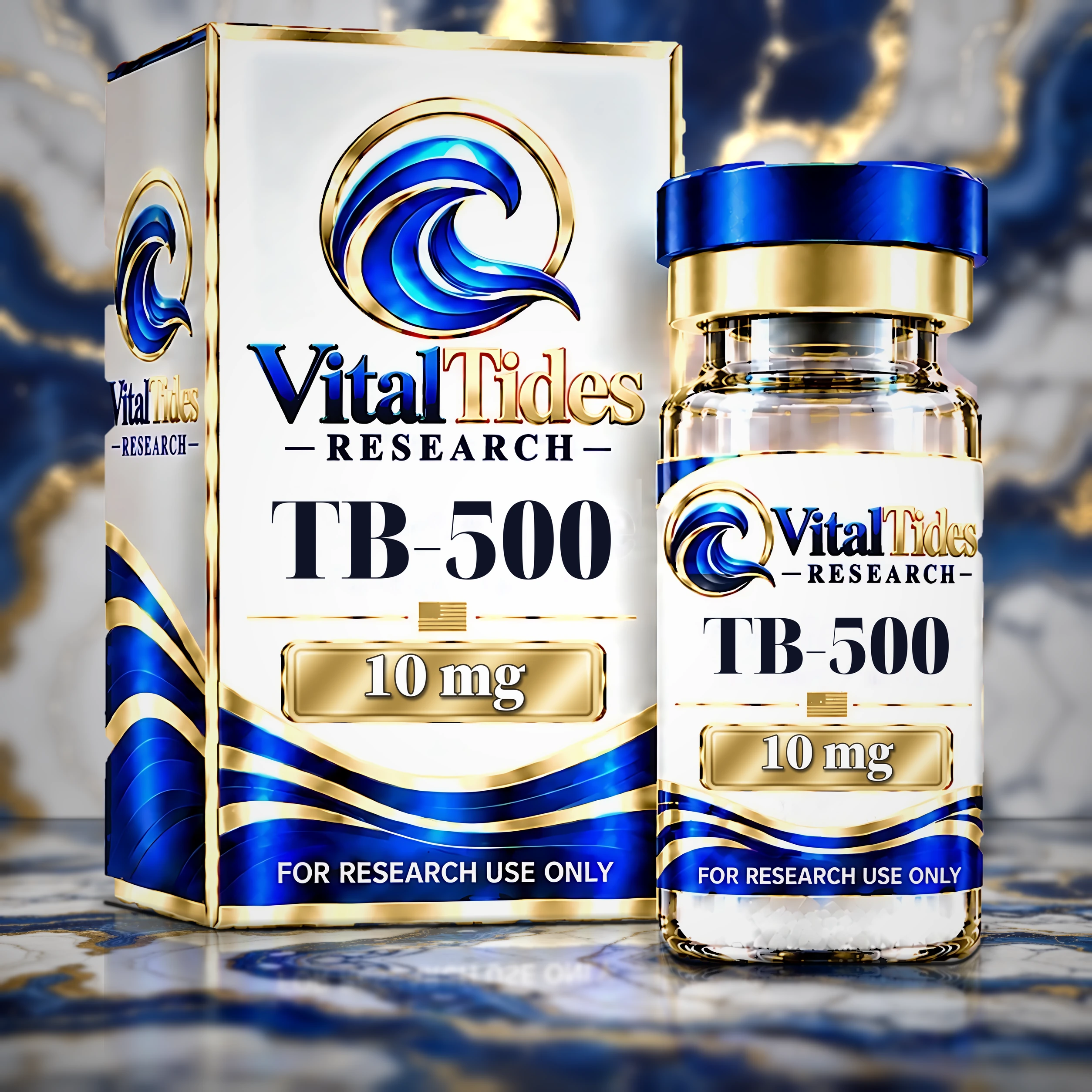
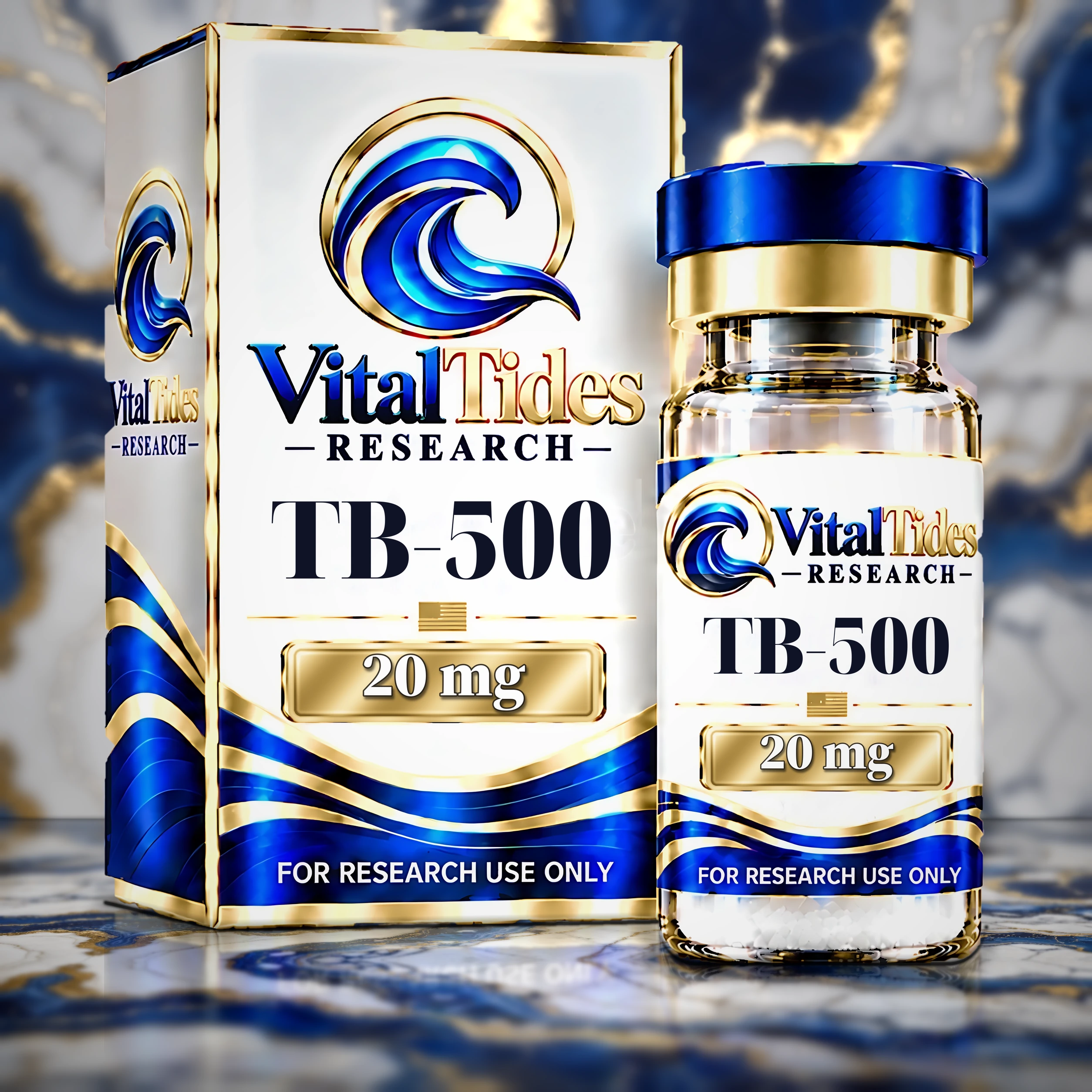
TB-500
Price range: $65.00 through $140.00
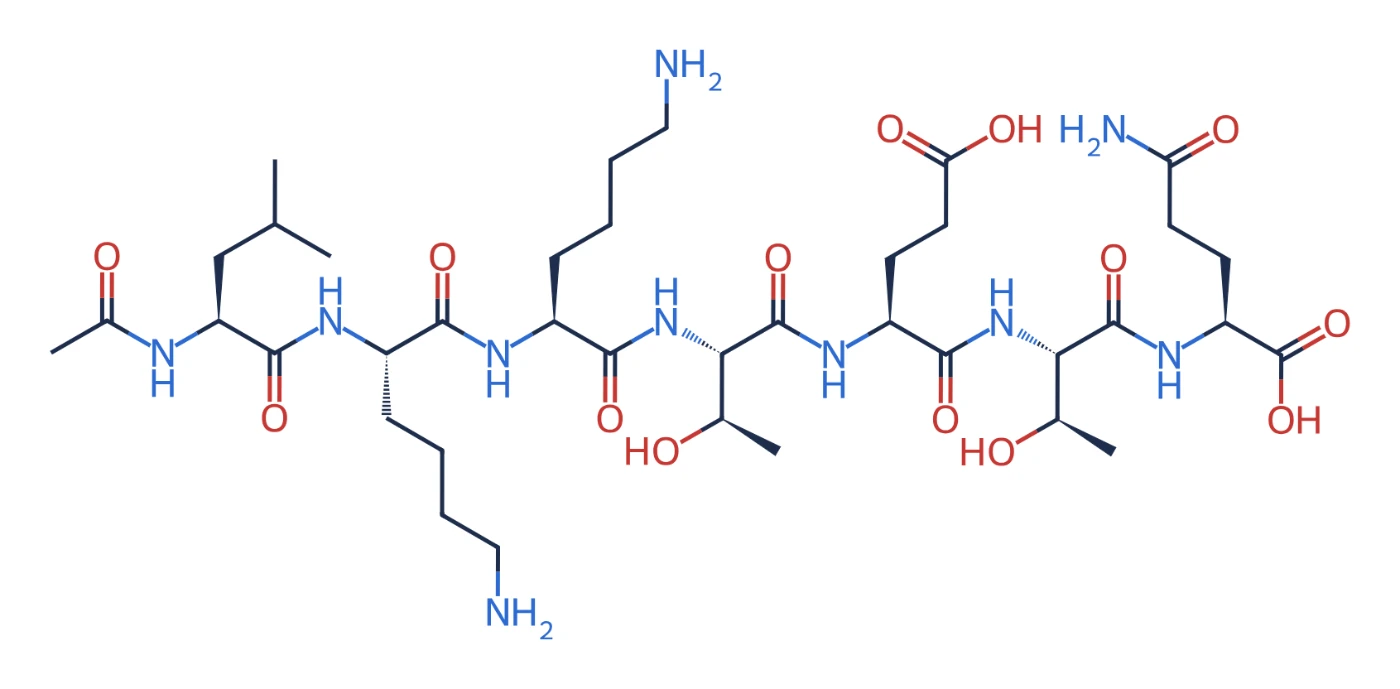
TB-500 (Ac-LKKTETQ), the acetylated seven-residue actin-binding fragment of thymosin beta-4 (residues 17–23), supplied as a lyophilized powder for research use only.
Description
TB-500 is a synthetic seven-residue peptide, Ac-Leu-Lys-Lys-Thr-Glu-Thr-Gln (Ac-LKKTETQ), with a molecular weight of 889.0 g/mol. It corresponds to residues 17 to 23 of thymosin beta-4 (Tβ4), the region identified in the literature as the protein’s actin-binding motif, and carries an acetyl group on its N-terminus. Vital Tides Research carries TB-500 in this short-chain form, supplied as a lyophilized powder for laboratory research use only.
Its parent protein, Tβ4, is found in nearly every nucleated cell and is the main actin-sequestering protein in the cell. It regulates the pool of actin monomers that cells draw on to remodel their cytoskeleton, change shape and migrate. The LKKTETQ sequence is the part of Tβ4 that engages actin, which is why this fragment became the focus of synthetic research.
Structure and stability
TB-500 has the molecular formula C38H68N10O14. The sequence is Leu-Lys-Lys-Thr-Glu-Thr-Gln, with an acetylated N-terminal leucine and a free carboxylic acid at the C-terminus.
Several structural features matter for laboratory work:
- Short and linear. Seven residues with no cysteine, so there are no disulfide bridges and no folded structure to preserve.
- Low oxidation risk. The sequence contains no methionine, tryptophan or cysteine, the residues most prone to oxidation in larger peptides.
- Highly water-soluble. Two lysines, a glutamic acid, two threonines and a glutamine make the peptide strongly polar, so it dissolves readily in aqueous diluents.
- N-terminal acetylation. The acetyl cap removes the free N-terminal amine, which reduces breakdown by aminopeptidases at that end of the chain.
Research background
Much of the published research in this area was carried out on the parent protein, Tβ4, and the great majority of it is in vitro work and animal studies, mostly in mice and rats. Findings for the parent protein cannot automatically be assumed to apply to the seven-residue fragment.
Actin binding. Biochemical and structural work located the actin-binding activity of Tβ4 in its central LKKTETQ region. That finding is the basis for studying the sequence as a stand-alone synthetic peptide.
Wound repair models. A 2003 study in murine models reported that a synthetic peptide containing the Tβ4 actin-binding domain, like the parent protein, accelerated closure of full-thickness dermal wounds. This remains the most cited direct work on the fragment.
Anti-doping analysis. Ac-LKKTETQ and its metabolites are specifically screened for in anti-doping testing, and Tβ4 and its fragments are on the World Anti-Doping Agency (WADA) prohibited list. Analytical methods developed for that purpose are a useful reference for identity testing.
It is important to understand the limits of this evidence base. TB-500 has not been approved by the FDA or any other regulatory authority for any use in humans. Results from rodent models frequently do not translate to other species. Research designs should not extrapolate beyond what the published models support.
Storage and handling
Store the lyophilized powder at 36 to 46 °F (2 to 8 °C), desiccated and protected from light. For longer-term storage of unopened vials, −4 °F (−20 °C) is commonly used. Before opening, allow the vial to reach room temperature so that condensation does not form inside it.
Purity and verification
Each lot is analyzed by an independent laboratory. Identity is confirmed by mass spectrometry, with the observed mass matching the acetylated LKKTETQ sequence at about 889 Da, and purity is measured by HPLC. Test scope varies by lot, so consult the certificate for the specific lot you receive.
Ac-LKKTETQ
Additional information
| Vial Size | 10mg, 20mg |
|---|---|
| Format |
Related products
-

WOLVERINE
Price range: $80.00 through $165.00Quick ViewSelect options This product has multiple variants. The options may be chosen on the product pageWOLVERINE
Price range: $80.00 through $165.00
A two-component preparation of BPC-157 and TB-500 (Ac-LKKTETQ) in one lyophilized vial, supplied for in-vitro laboratory research. Identity of both components confirmed by LC-MS.
-
BPC-157
Price range: $65.00 through $120.00Quick ViewSelect options This product has multiple variants. The options may be chosen on the product pageBPC-157
Price range: $65.00 through $120.00
A 15-amino-acid peptide derived from a protein found in gastric juice, studied in preclinical models of tissue repair, angiogenesis and mucosal integrity. Supplied as lyophilized powder, identity confirmed by mass spectrometry.
-

GHK-CU
Price range: $46.00 through $65.00Quick ViewSelect options This product has multiple variants. The options may be chosen on the product pageGHK-CU
Price range: $46.00 through $65.00
A copper-binding tripeptide (Gly-His-Lys) supplied as the 1:1 Cu(II) complex, studied in preclinical work on extracellular matrix synthesis, gene expression and angiogenesis. Blue lyophilized powder.
-