GHK-CU
Price range: $46.00 through $65.00
A copper-binding tripeptide (Gly-His-Lys) supplied as the 1:1 Cu(II) complex, studied in preclinical work on extracellular matrix synthesis, gene expression and angiogenesis. Blue lyophilized powder.
Description
GHK-Cu is a copper-binding tripeptide with the sequence glycyl-L-histidyl-L-lysine, supplied as the 1:1 copper(II) complex. It occurs naturally in human plasma, where its concentration has been reported to decline with age, and it is also found in saliva and urine. The complex has a molecular weight of 403.93 g/mol and appears as a distinctive blue powder, the colour arising from the coordinated copper ion.
The copper distinction
Two different substances are sold under closely related names, and the difference matters for any quantitative work. The copper complex, GHK-Cu, carries CAS 89030-95-5 and weighs 403.93 g/mol. The metal-free tripeptide, GHK alone, carries CAS 49557-75-7 and weighs 340.38 g/mol. The material supplied here is the copper complex, which is why the powder is blue rather than white. A white powder sold as GHK-Cu is worth questioning.
Structure and coordination
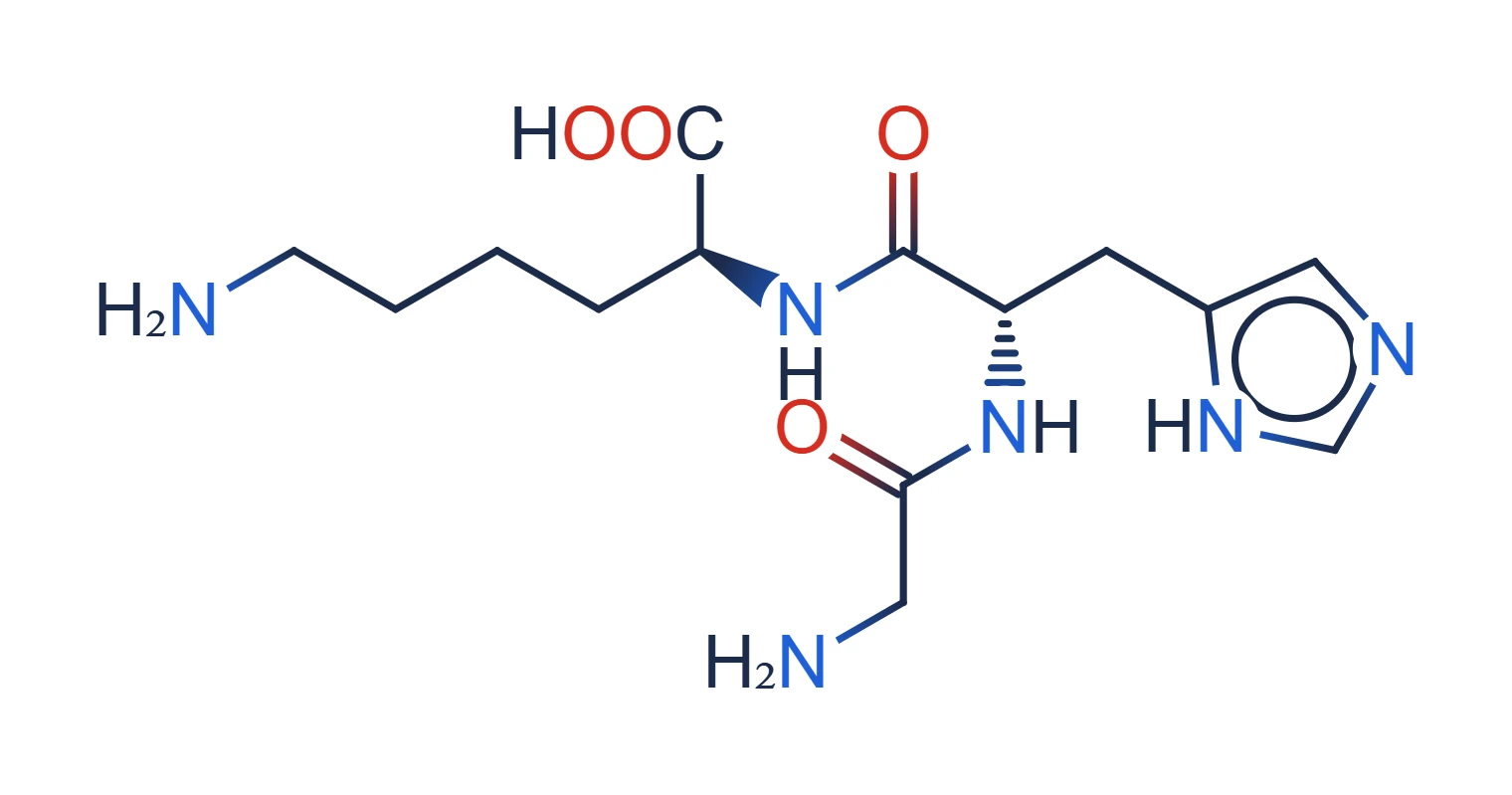
The tripeptide binds Cu(II) through the imidazole nitrogen of the histidine residue, the amino terminus, and the deprotonated amide nitrogen of the peptide backbone. This arrangement produces a stable square-planar complex. The binding affinity is high enough that GHK can compete for copper with albumin, the principal copper carrier in plasma, and this exchange behaviour is the basis for much of the published interest in the molecule as a copper delivery vehicle rather than simply as a peptide.
Research background
GHK-Cu has one of the longer research histories of any peptide in this catalogue, dating to the 1970s, and the literature is correspondingly broad. Almost all of it is in vitro or animal work.
The earliest published observations concerned the behaviour of the molecule in cell culture systems. Subsequent work examined its relationship to extracellular matrix components, with a considerable body of study on collagen and glycosaminoglycan synthesis in fibroblast cultures.
A second area concerns gene expression. Published transcriptomic work has reported that exposure to GHK-Cu is associated with altered expression across a large number of human genes in cultured cells, and this dataset is frequently cited as the basis for interest in the molecule beyond its structural role.
A third area concerns angiogenesis and cell migration in assay systems, and a fourth concerns antioxidant behaviour, which is of interest partly because copper complexes participate in redox chemistry in ways free peptides do not.
In the formulation literature GHK-Cu is indexed under the INCI name copper tripeptide-1. No regulatory authority has approved GHK-Cu as a therapeutic. Findings in cultured cells and animal models frequently do not translate to other contexts.
Storage and handling
Store the lyophilized powder at 36 to 46 °F (2 to 8 °C), desiccated and protected from light. Allow the vial to reach room temperature before opening.
Purity and verification
Each lot is analysed by an independent laboratory, with identity confirmed by mass spectrometry and purity by HPLC. Note that copper complexes can lose the metal ion during electrospray ionisation, so a mass spectrum may show the free tripeptide. Test scope varies by lot; consult the certificate for the lot you receive.
GHK
Additional information
| Vial Size | 50mg, 100mg |
|---|---|
| Format |
Related products
-

-

ARA-290
Price range: $60.00 through $70.00Quick ViewSelect options This product has multiple variants. The options may be chosen on the product pageARA-290
Price range: $60.00 through $70.00
An 11-amino-acid peptide from the helix B surface of erythropoietin, engineered to engage tissue-protective signalling without erythropoietic activity.
-

GLOW
Price range: $95.00 through $105.00Quick ViewSelect options This product has multiple variants. The options may be chosen on the product pageGLOW
Price range: $95.00 through $105.00
A three-component preparation of GHK-Cu, BPC-157 and TB-500 (Ac-LKKTETQ) in one lyophilized vial. Blue powder from the copper complex; all three components confirmed by LC-MS.
-