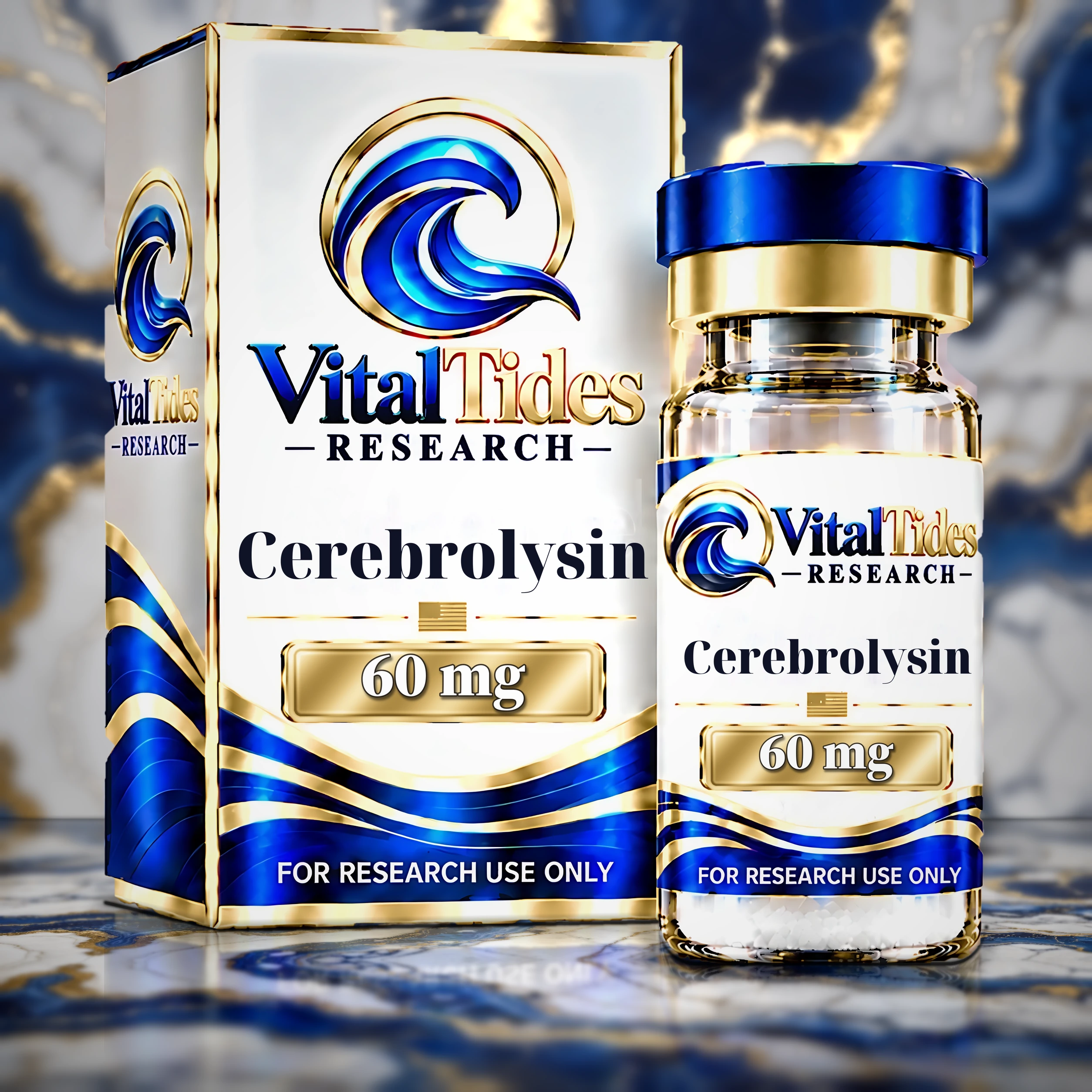
CEREBROLYSIN
$65.00
1000 in stock
A porcine brain-derived preparation of low-molecular-weight peptides and free amino acids, not a single defined compound. No molecular formula or single molecular weight applies.
Description
Cerebrolysin is not a single compound. It is a preparation of low-molecular-weight peptides and free amino acids obtained from purified porcine brain tissue, and it is registered under CAS 12656-61-0 as a substance of undefined composition rather than as a defined molecule.
Why there is no molecular weight on this page
Every other product in this catalogue has a CAS number, a molecular formula and a molecular weight, because each is a single chemical entity. Cerebrolysin has none of the latter two, and this is not an omission.
The preparation is produced by standardised enzymatic breakdown of lipid-free brain proteins, followed by separation and purification. The result is a mixture: peptide constituents ranging up to approximately 10,000 daltons, with free amino acids making up the balance. Reported figures put the low-molecular-weight peptide fraction at around 25 percent of total nitrogen content.
Mass spectrometric characterisation identifies a complex mixture of short-chain peptides rather than one dominant species. There is therefore no single mass to state, and any supplier quoting a molecular weight for Cerebrolysin is describing something other than the preparation itself.
What this means for research design
Working with a tissue-derived mixture differs from working with a synthetic peptide in ways worth planning for.
Composition is not standardised across batches in the way a single-molecule compound is, so lot-to-lot variation is inherent rather than exceptional. Concentration cannot be expressed molar, only as mass or volume of preparation. Attributing an observed effect to a specific constituent is not possible without further fractionation. And comparison against published work requires knowing which preparation and which lot that work used.
None of this makes the material unusable, but it does mean the experimental controls appropriate to a defined compound are not sufficient here.
Research background
Cerebrolysin has been described in the published literature over several decades, principally from European and Asian research groups. It is not approved in the United States, and the material supplied here is for laboratory research only.
Published preclinical work has examined neurotrophic activity in cell culture and animal models.
The material supplied here is for laboratory research only.
A note on sourcing
Cerebrolysin is a proprietary preparation produced by a single manufacturer, and the published literature refers specifically to that product. Material sold under the same name from other sources may differ in composition, production method and concentration. Researchers comparing against the clinical literature should confirm the provenance of their material rather than assume equivalence.
Handling
Refer to the certificate of analysis and any documentation supplied with your lot for storage and handling conditions, since these depend on the form in which the preparation is supplied.
Verification
Consult the certificate of analysis for the specific lot you receive. Given the nature of the preparation, lot documentation carries more weight here than it does for defined compounds.
Additional information
| Vial Size | 60mg |
|---|---|
| Format |
Related products
-
DSIP
Price range: $60.00 through $75.00Quick ViewSelect options This product has multiple variants. The options may be chosen on the product pageDSIP
Price range: $60.00 through $75.00
A nine-amino-acid peptide isolated in the 1970s and named for the sleep context of its discovery. No specific receptor has been definitively characterised.
-
-
DIHEXA
Price range: $52.00 through $85.00Quick ViewSelect options This product has multiple variants. The options may be chosen on the product pageDIHEXA
Price range: $52.00 through $85.00
A lipophilic angiotensin IV derivative that binds hepatocyte growth factor and potentiates c-Met signalling, studied in neurite outgrowth and rodent cognitive models.
-