KPV
Price range: $65.00 through $120.00
The C-terminal tripeptide of alpha-MSH (Lys-Pro-Val), studied in cell and rodent models of inflammatory signalling without the pigmentary activity of the parent hormone.
Description
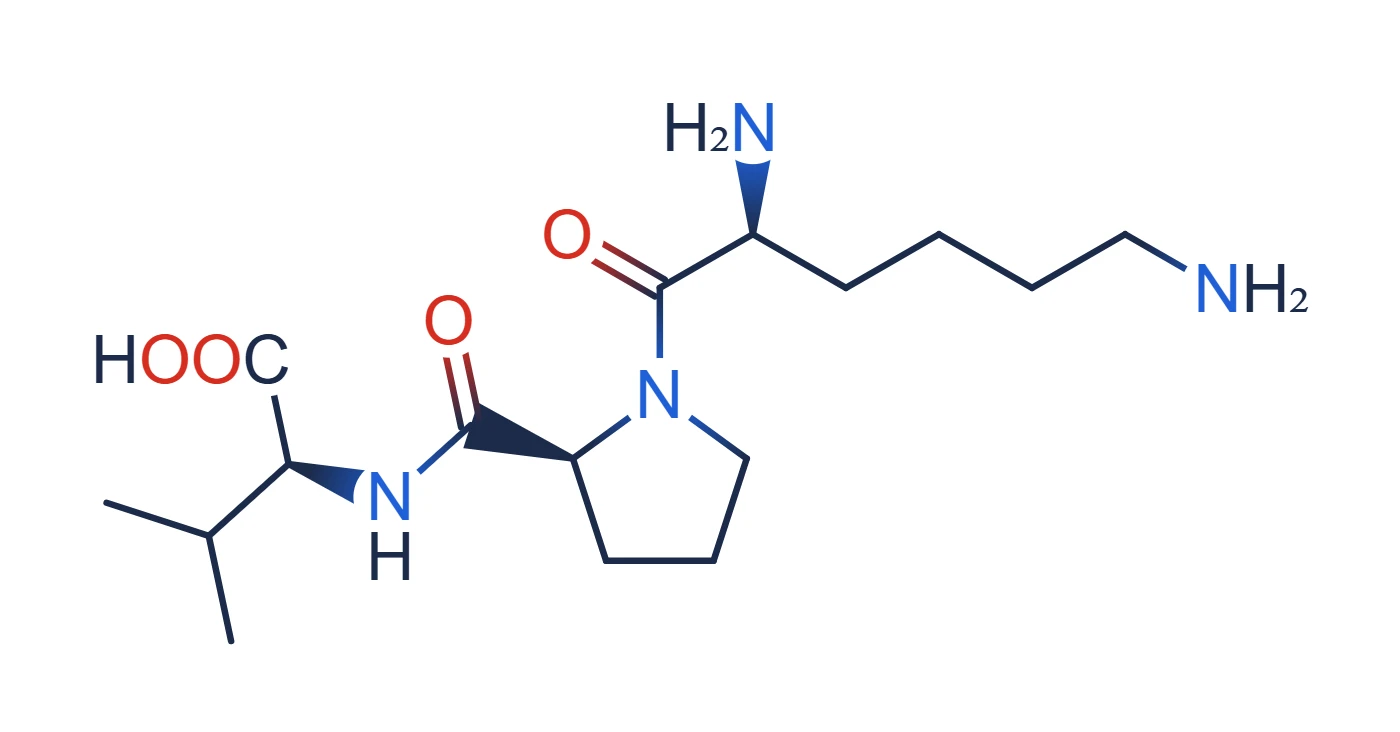
KPV is a tripeptide with the sequence Lys-Pro-Val and a molecular weight of 342.44 g/mol. It is the smallest peptide in this catalogue at three residues, and corresponds to the C-terminal fragment of alpha-melanocyte-stimulating hormone.
Structural basis
Alpha-MSH is a 13-residue hormone with a broad activity profile, including pigmentation signalling through melanocortin receptors. KPV reproduces only its final three residues, positions 11 to 13.
That truncation is the interesting part. Published work describes KPV as retaining the anti-inflammatory behaviour associated with the parent hormone while lacking its pigmentary activity, because the receptor interactions responsible for pigmentation depend on sequence elements that the tripeptide does not contain. Separating one property from another by truncation is a recurring strategy in peptide research, and KPV is one of the cleaner examples of it.
Compare this with Melanotan I and II, also in this catalogue, which are alpha-MSH analogues engineered to retain and extend the pigmentary activity that KPV discards. The three products derive from the same parent hormone and pursue opposite halves of its profile.
Research background
Published work on KPV is principally in vitro and rodent based.
The most cited area concerns inflammatory signalling. Studies have examined the tripeptide in relation to nuclear factor kappa B signalling in cultured cells, which is the mechanism most frequently proposed for the observations reported in inflammation models.
A second area concerns intestinal models, where published work has investigated the peptide in experimentally induced colitis in rodents, and examined transport into cells via peptide transporter routes.
A third area concerns antimicrobial observations in culture, reflecting a property also reported for the parent hormone.
No regulatory authority has approved KPV for any use. Findings in rodent and cell systems frequently do not translate to other species.
Storage and handling
Store the lyophilized powder at 36 to 46 °F (2 to 8 °C), desiccated and protected from light. Allow the vial to reach room temperature before opening.
Purity and verification
Each lot is analysed by an independent laboratory, with identity confirmed by mass spectrometry and purity by HPLC. Test scope varies by lot; consult the certificate for the lot you receive.
KPV
Additional information
| Vial Size | 10mg, 20mg |
|---|---|
| Format |
Related products
-

WOLVERINE
Price range: $80.00 through $165.00Quick ViewSelect options This product has multiple variants. The options may be chosen on the product pageWOLVERINE
Price range: $80.00 through $165.00
A two-component preparation of BPC-157 and TB-500 (Ac-LKKTETQ) in one lyophilized vial, supplied for in-vitro laboratory research. Identity of both components confirmed by LC-MS.
-

GHK-CU
Price range: $46.00 through $65.00Quick ViewSelect options This product has multiple variants. The options may be chosen on the product pageGHK-CU
Price range: $46.00 through $65.00
A copper-binding tripeptide (Gly-His-Lys) supplied as the 1:1 Cu(II) complex, studied in preclinical work on extracellular matrix synthesis, gene expression and angiogenesis. Blue lyophilized powder.
-

-

GLOW
Price range: $95.00 through $105.00Quick ViewSelect options This product has multiple variants. The options may be chosen on the product pageGLOW
Price range: $95.00 through $105.00
A three-component preparation of GHK-Cu, BPC-157 and TB-500 (Ac-LKKTETQ) in one lyophilized vial. Blue powder from the copper complex; all three components confirmed by LC-MS.