


MOTS-C
Price range: $115.00 through $160.00
A 16-amino-acid mitochondrial-derived peptide encoded within the 12S rRNA gene, studied in preclinical work on AMPK signalling, glucose handling and metabolic regulation.
Description
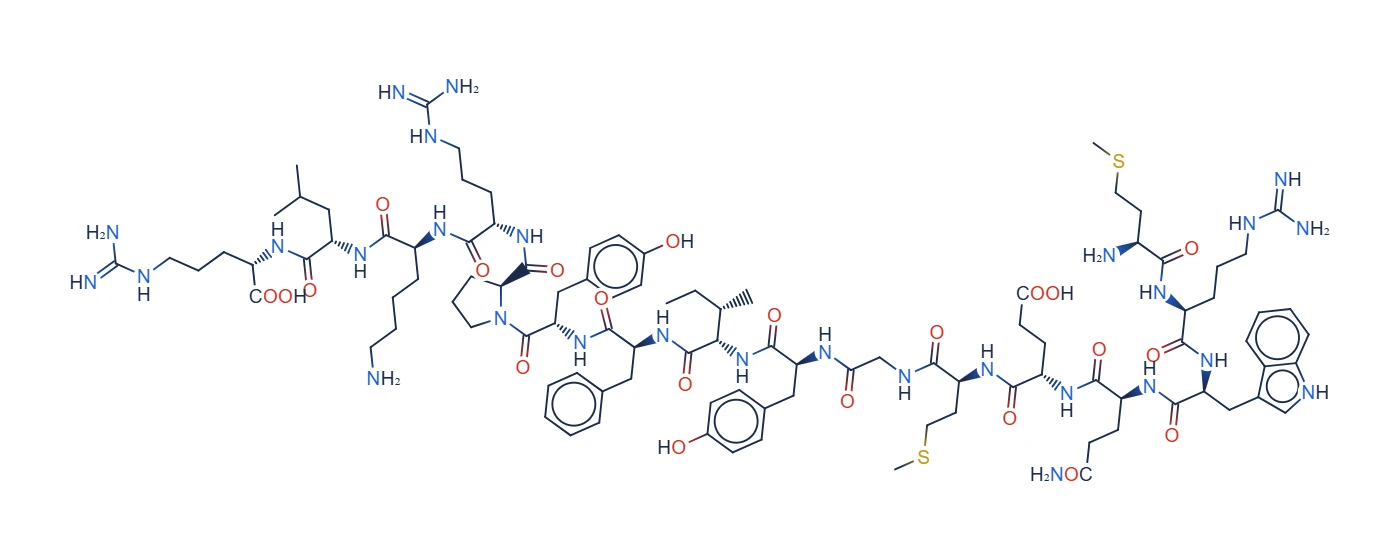
MOTS-c is a 16-amino-acid peptide of sequence MRWQEMGYIFYPRKLR, with a molecular weight of approximately 2174.6 g/mol. Its name stands for Mitochondrial Open Reading Frame of the Twelve S rRNA type-c, which describes its unusual origin.
Why the origin is unusual
Almost every protein in a mammalian cell is encoded by nuclear DNA. MOTS-c is not. It is encoded within the mitochondrial genome, specifically in a short open reading frame inside the 12S ribosomal RNA gene, MT-RNR1. This places it in a small class of molecules known as mitochondrial-derived peptides, of which humanin was the first described.
This matters for research framing. A peptide encoded by mitochondrial DNA that appears to act outside the mitochondrion implies a signalling route from the organelle to the rest of the cell, and it is that retrograde signalling concept, rather than any single downstream effect, that drives most published interest in the molecule.
Research background
MOTS-c was first described in the published literature in 2015, making it one of the more recently characterised peptides in this catalogue. The body of work is correspondingly smaller than for older compounds, and consists principally of cell culture systems and rodent models.
The foundational area concerns metabolic regulation. Published work has examined the peptide in relation to AMP-activated protein kinase signalling, a central sensor of cellular energy state, and to the folate and methionine one-carbon metabolic pathway.
A second area concerns insulin sensitivity and glucose handling, studied in rodent models and in cultured cells.
A third area concerns exercise physiology. Published observations have reported changes in circulating MOTS-c levels associated with physical activity, which has prompted investigation of the peptide as a potential exercise-associated signalling molecule.
A fourth area concerns nuclear translocation. Studies have reported that under metabolic stress the peptide can move to the nucleus and associate with transcriptional regulators, which would represent a direct mitochondria-to-nucleus signalling route.
Researchers should treat this field as developing rather than settled. MOTS-c has not completed human clinical trials and no regulatory authority has approved it for any use. Much of the published work is relatively recent, and findings in rodent models frequently do not translate to other species.
Storage and handling
Store the lyophilized powder at 36 to 46 °F (2 to 8 °C), desiccated and protected from light. Allow the vial to reach room temperature before opening.
Use 2174.6 g/mol for molar calculations. Note that reported masses for this peptide vary slightly across suppliers, generally between 2174.3 and 2174.6, depending on whether average or monoisotopic mass is quoted and on salt form. For precise work, use the figure on your lot certificate.
Purity and verification
Each lot is analysed by an independent laboratory, with identity confirmed by mass spectrometry and purity by HPLC. Test scope varies by lot; consult the certificate for the lot you receive.
MRWQEMGYIFYPRKLR
Additional information
| Vial Size | 20mg, 40mg |
|---|---|
| Format |
Related products
-

EPITALON
Price range: $50.00 through $125.00Quick ViewSelect options This product has multiple variants. The options may be chosen on the product pageEPITALON
Price range: $50.00 through $125.00
A synthetic tetrapeptide (Ala-Glu-Asp-Gly) from the Khavinson bioregulator programme, studied in cell-culture work on telomerase activity and in animal models of circadian regulation.
-

NAD+
Price range: $60.00 through $100.00Quick ViewSelect options This product has multiple variants. The options may be chosen on the product pageNAD+
Price range: $60.00 through $100.00
Oxidised nicotinamide adenine dinucleotide, a dinucleotide coenzyme central to redox metabolism and a consumed substrate for sirtuins, PARPs and CD38. Not a peptide.
-

G2X-TZ
Price range: $85.00 through $235.00Quick ViewSelect options This product has multiple variants. The options may be chosen on the product pageG2X-TZ
Price range: $85.00 through $235.00
A lipidated 39-amino-acid dual agonist acting at the GIP and GLP-1 receptors, built on a GIP-analogue backbone, studied in metabolic research. Supplied as lyophilized powder, identity confirmed by mass spectrometry.
-

SS-31
Price range: $65.00 through $140.00Quick ViewSelect options This product has multiple variants. The options may be chosen on the product pageSS-31
Price range: $65.00 through $140.00
A mitochondria-targeted aromatic-cationic tetrapeptide (elamipretide) that associates with cardiolipin in the inner mitochondrial membrane, studied in models of oxidative stress and ischaemia-reperfusion.