EPITALON
Price range: $50.00 through $125.00
A synthetic tetrapeptide (Ala-Glu-Asp-Gly) from the Khavinson bioregulator programme, studied in cell-culture work on telomerase activity and in animal models of circadian regulation.
Description
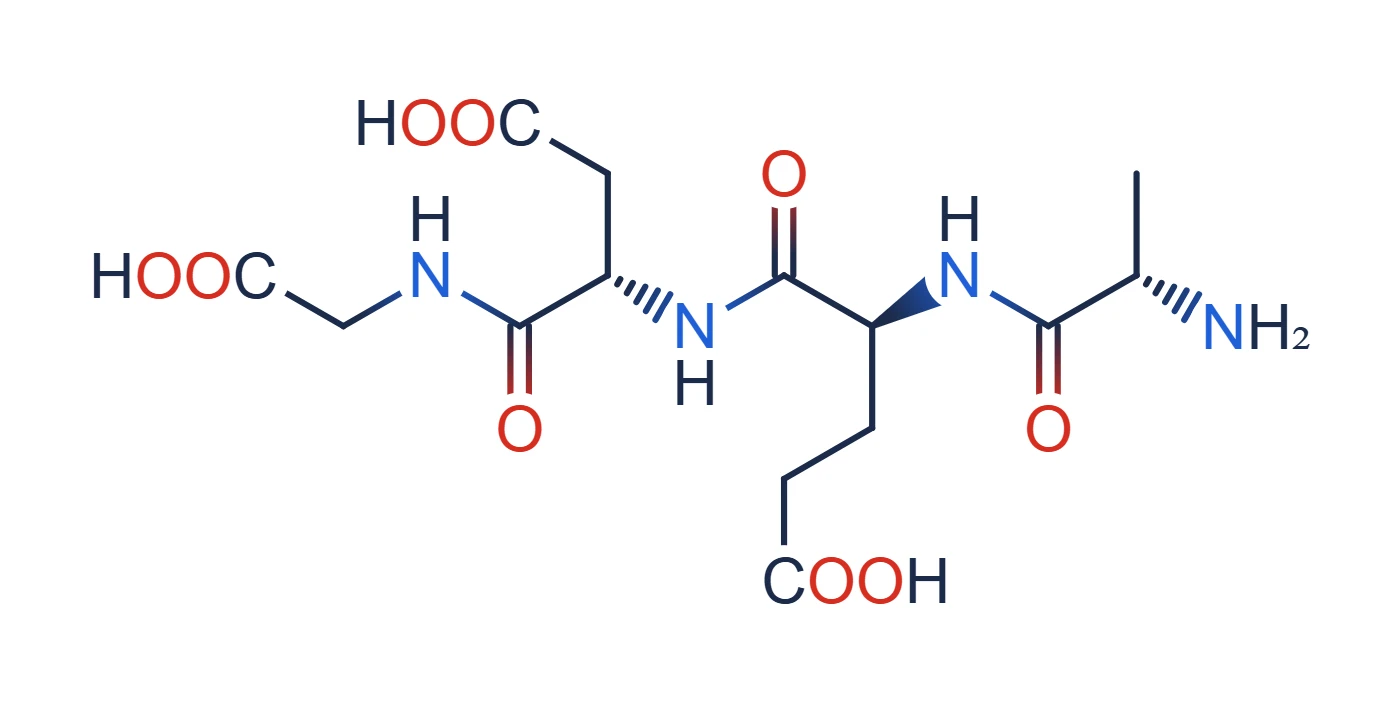
Epitalon is a synthetic tetrapeptide with the sequence Ala-Glu-Asp-Gly, abbreviated AEDG, with a molecular weight of 390.35 g/mol. It is also written as epithalon or epithalamin in the literature, and is among the shortest peptides in this catalogue at four residues.
Origin
Epitalon emerged from the Russian peptide bioregulator research programme led by Vladimir Khavinson at the St Petersburg Institute of Bioregulation and Gerontology. That programme worked from the premise that short peptide sequences extracted from specific tissues could act as regulatory signals, and it produced a family of synthetic tetrapeptides of which Epitalon is the best known. Pinealon, also in this catalogue, comes from the same lineage.
Epitalon was developed as a synthetic counterpart to epithalamin, a peptide preparation obtained from bovine pineal tissue. The synthetic tetrapeptide has the advantage of being a single defined molecule rather than a tissue extract of variable composition, which makes it far more suitable for controlled laboratory work.
Research background
Researchers approaching this compound should understand the shape of its literature before designing experiments. A substantial proportion of published work originates from a single research group and much of it appeared in Russian-language journals, some of which are not widely indexed. Independent replication outside that group is limited compared with peptides of similar profile.
The most frequently cited area of investigation concerns telomerase. Published work has reported effects on telomerase activity in cultured human somatic cells, which is the basis for most interest in the molecule and the reason it appears in longevity research contexts.
A second area concerns the pineal gland and circadian regulation, reflecting the compound’s derivation from a pineal preparation. Studies have examined melatonin rhythms in animal models.
A third area concerns antioxidant and chromatin-related observations in cell systems.
Epitalon has not completed registration-standard human clinical trials, and no regulatory authority outside its country of origin has approved it for any use. Given the concentration of the literature in a small number of sources, researchers should weight findings accordingly and treat independent verification as a priority rather than an afterthought.
Storage and handling
Store the lyophilized powder at 36 to 46 °F (2 to 8 °C), desiccated and protected from light. Allow the vial to reach room temperature before opening.
Purity and verification
Each lot is analysed by an independent laboratory, with identity confirmed by mass spectrometry and purity by HPLC. Test scope varies by lot; consult the certificate for the lot you receive.
AEDG
Additional information
| Vial Size | 10mg, 50mg |
|---|---|
| Format |
Related products
-
SS-31
Price range: $65.00 through $140.00Quick ViewSelect options This product has multiple variants. The options may be chosen on the product pageSS-31
Price range: $65.00 through $140.00
A mitochondria-targeted aromatic-cationic tetrapeptide (elamipretide) that associates with cardiolipin in the inner mitochondrial membrane, studied in models of oxidative stress and ischaemia-reperfusion.
-
MOTS-C
Price range: $115.00 through $160.00Quick ViewSelect options This product has multiple variants. The options may be chosen on the product pageMOTS-C
Price range: $115.00 through $160.00
A 16-amino-acid mitochondrial-derived peptide encoded within the 12S rRNA gene, studied in preclinical work on AMPK signalling, glucose handling and metabolic regulation.
-
-
NAD+
Price range: $60.00 through $100.00Quick ViewSelect options This product has multiple variants. The options may be chosen on the product pageNAD+
Price range: $60.00 through $100.00
Oxidised nicotinamide adenine dinucleotide, a dinucleotide coenzyme central to redox metabolism and a consumed substrate for sirtuins, PARPs and CD38. Not a peptide.