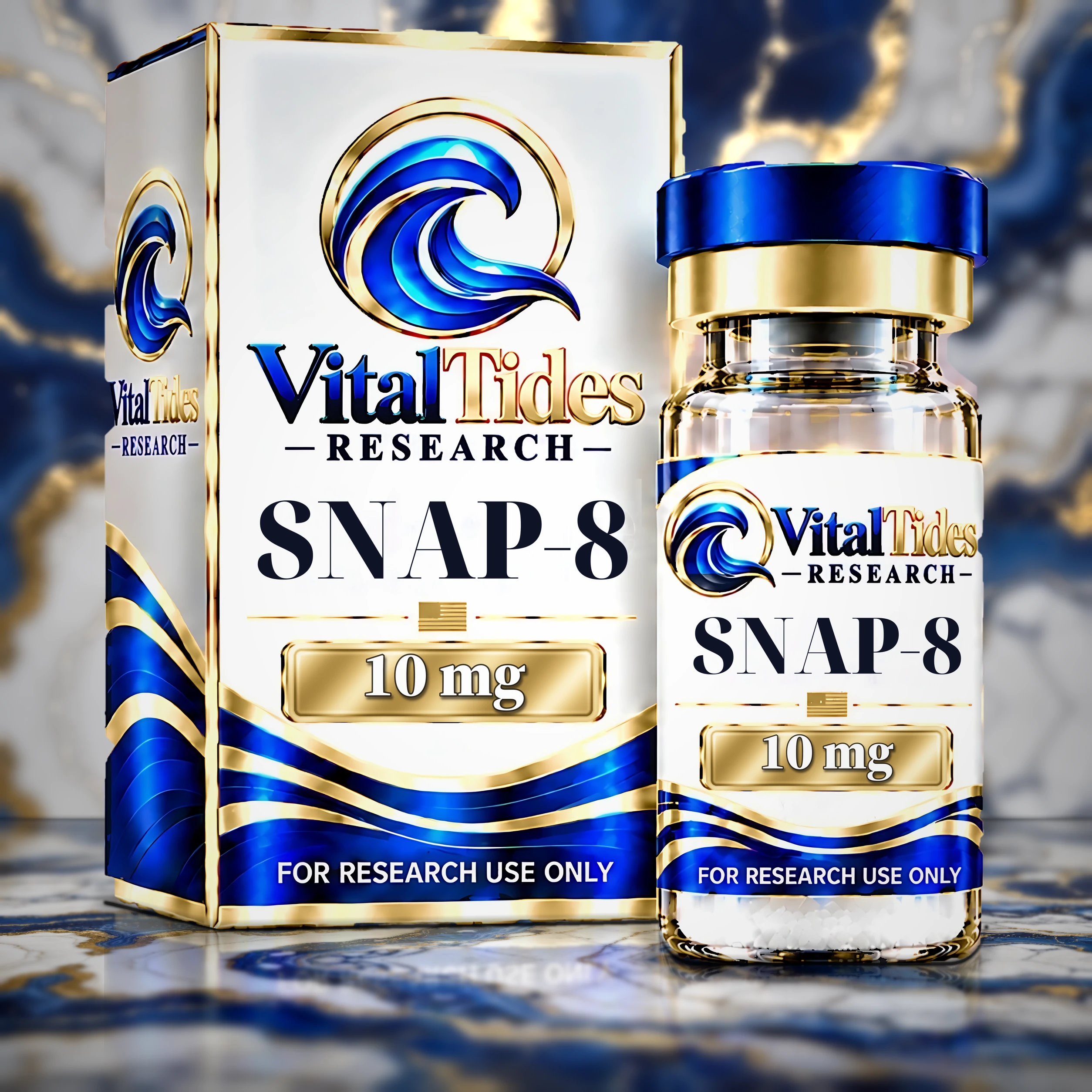
SNAP-8
$58.00
1000 in stock
An acetylated octapeptide (Acetyl Octapeptide-3) designed to mimic the N-terminal region of SNAP-25 and compete within the SNARE complex. Studied in topical formulation research.
Description
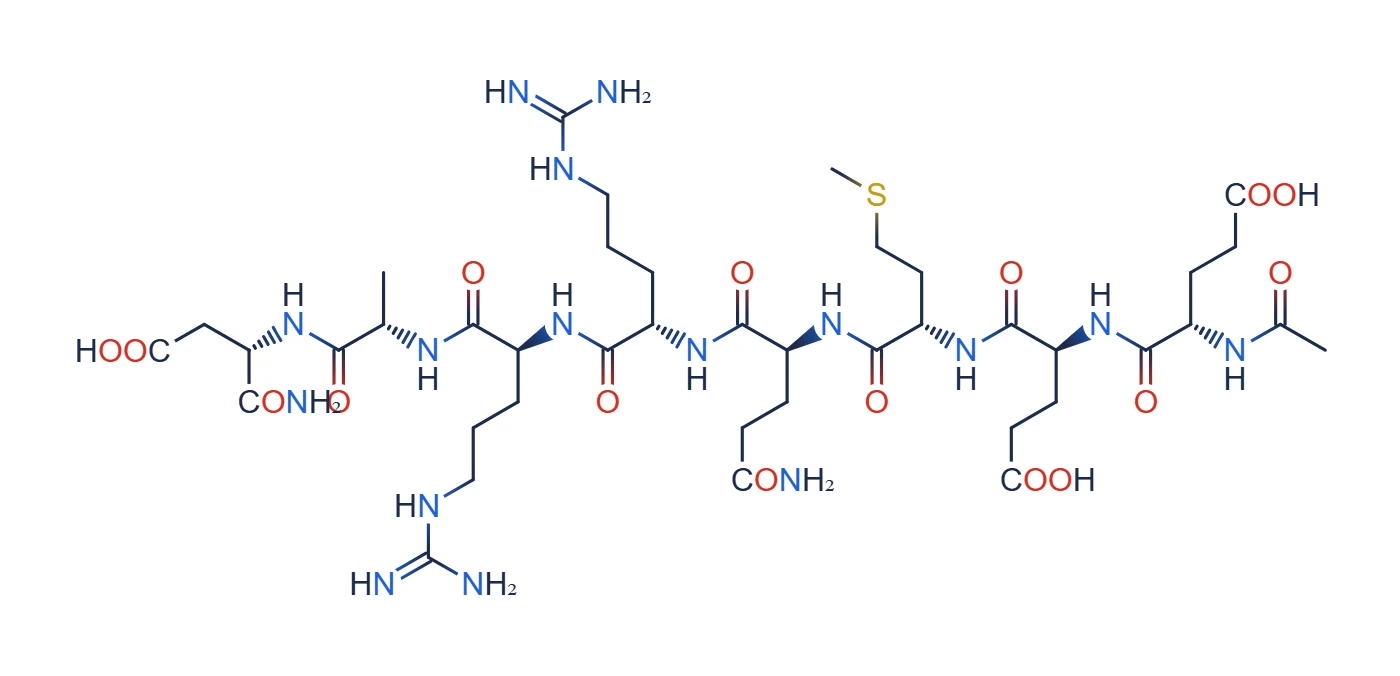
SNAP-8 is an eight-amino-acid peptide with the sequence Ac-Glu-Glu-Met-Gln-Arg-Arg-Ala-Asp-NH₂ and a molecular weight of 1075.16 g/mol. Its cosmetic ingredient name is Acetyl Octapeptide-3, and it also appears as acetyl glutamyl heptapeptide-3.
Formulation research context
SNAP-8 differs from most of this catalogue in its research context. It is indexed as a cosmetic formulation ingredient, and the published work concerns its behaviour in topical formulation studies rather than systemic research models.
Researchers should note the INCI designation above, since formulation literature and regulatory documentation index the compound under that name rather than SNAP-8.
Mechanism
SNAP-8 is designed to mimic the N-terminal region of SNAP-25, a component of the SNARE complex.
The SNARE complex is the protein assembly that docks neurotransmitter vesicles to the presynaptic membrane before release. SNAP-25 is one of three proteins forming that complex. The premise behind SNAP-8 is competitive interference: a peptide resembling the N-terminal region of SNAP-25 may compete for a position in the assembling complex, destabilising it.
This is the same protein target that botulinum toxin acts on, though by an entirely different route. Botulinum toxin is an enzyme that cleaves SNAP-25; SNAP-8 is a peptide proposed to compete with it sterically. Comparisons between the two are common in marketing material but the mechanisms are not equivalent, and the effect sizes reported are not comparable.
Research background
Published work has examined the peptide in formulation and in cell-based systems relating to SNARE complex assembly.
Researchers should be aware that the independent evidence base is thin. There is limited peer-reviewed work testing SNAP-8 alone, as distinct from formulations containing multiple actives, and the efficacy figures widely quoted for it originate from manufacturer testing rather than independent replication. Any experimental design should treat published effect sizes with caution.
Handling
Store the powder at 36 to 46 °F (2 to 8 °C) for short-term use, or at −4 °F (−20 °C) desiccated for longer storage. Protect from light.
The sequence contains a methionine residue, which is susceptible to oxidation. The two arginine and two glutamate residues make the peptide strongly charged and readily water-soluble.
Use 1075.16 g/mol for molar calculations. Note that some supplier listings quote a formula and mass that do not agree with the majority of sources; the figure here is corroborated by independent certificates of analysis.
Store solutions cold and protected from light, and avoid repeated freeze-thaw cycles.
Purity and verification
Each lot is analysed by an independent laboratory, with identity confirmed by mass spectrometry and purity by HPLC. Test scope varies by lot; consult the certificate for the lot you receive.
N-terminal acetylation
Additional information
| Vial Size | 10mg |
|---|---|
| Format |
Related products
-

GHK-CU
Price range: $46.00 through $65.00Quick ViewSelect options This product has multiple variants. The options may be chosen on the product pageGHK-CU
Price range: $46.00 through $65.00
A copper-binding tripeptide (Gly-His-Lys) supplied as the 1:1 Cu(II) complex, studied in preclinical work on extracellular matrix synthesis, gene expression and angiogenesis. Blue lyophilized powder.
-

-

-