


SS-31
Price range: $65.00 through $140.00
A mitochondria-targeted aromatic-cationic tetrapeptide (elamipretide) that associates with cardiolipin in the inner mitochondrial membrane, studied in models of oxidative stress and ischaemia-reperfusion.
Description
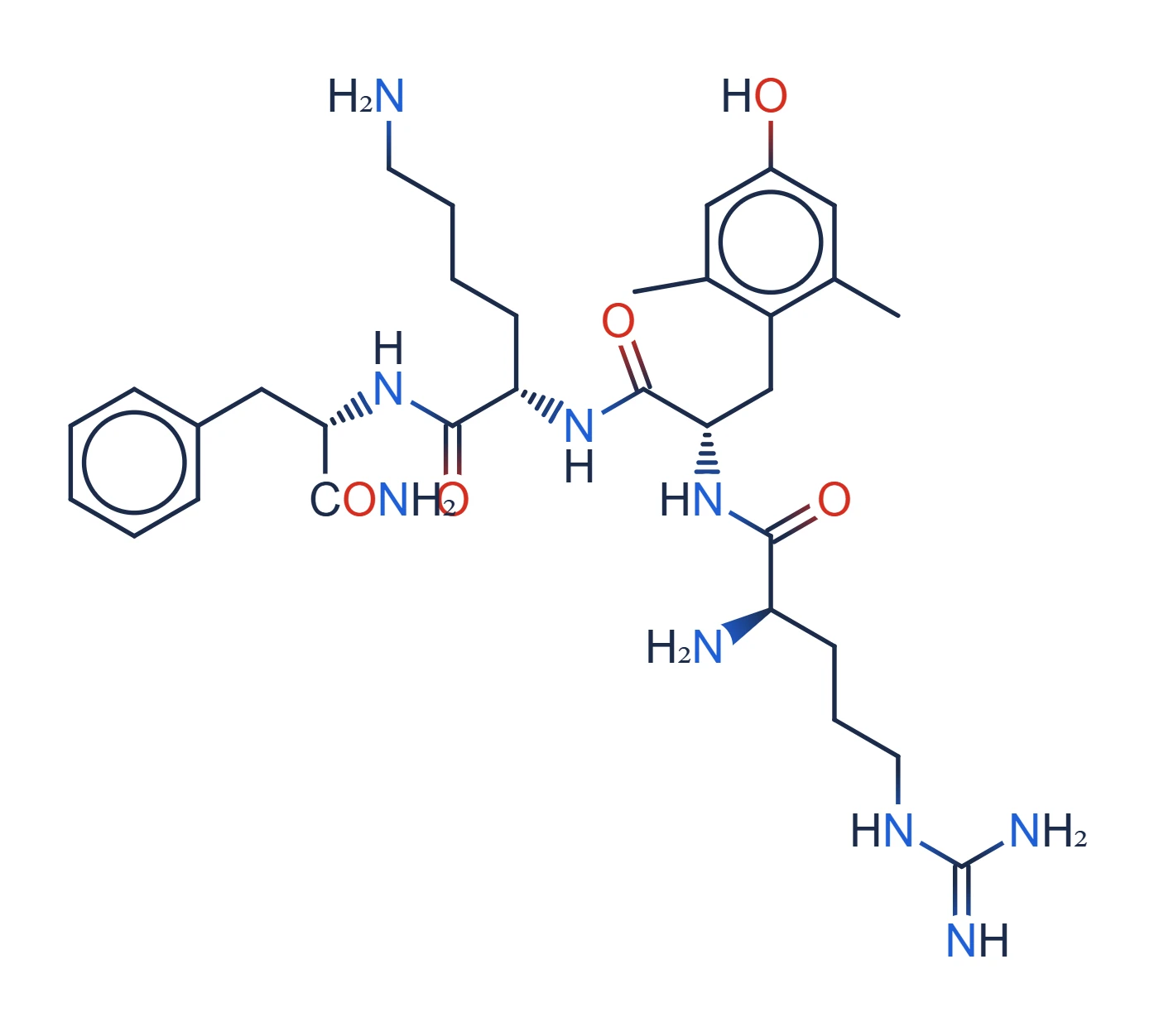
SS-31 is a synthetic tetrapeptide with the sequence D-Arg-Dmt-Lys-Phe-NH₂, where Dmt denotes 2,6-dimethyl-L-tyrosine and the C-terminus is amidated. It belongs to the Szeto-Schiller family of aromatic-cationic peptides and is also known as elamipretide, MTP-131 and Bendavia. Molecular weight is 639.8 g/mol.
Structure and targeting
The defining structural feature is an alternating aromatic-cationic motif: positively charged residues interleaved with aromatic ones. This arrangement is what gives the peptide its selectivity for the inner mitochondrial membrane, and it is the reason the molecule is described as mitochondria-targeted rather than simply cell-permeable.
Published work describes the peptide associating with cardiolipin, a phospholipid found almost exclusively in the inner mitochondrial membrane and essential to the organisation of the respiratory chain complexes. Unlike many targeting strategies, this association is reported not to depend on membrane potential, which is significant because damaged mitochondria lose potential and would otherwise be inaccessible to potential-dependent probes.
Two of the four residues are non-standard. D-arginine at position one and 2,6-dimethyltyrosine at position two both contribute to resistance against enzymatic degradation, which is a common design strategy in short synthetic peptides.
Research background
SS-31 has one of the more developed research profiles in this catalogue, with published work spanning in vitro systems, animal models and human clinical investigation.
The foundational area concerns cardiolipin binding and respiratory chain organisation. Laboratory studies have examined how association with cardiolipin relates to the structural arrangement of the inner membrane and to electron transport efficiency in isolated mitochondria.
A second area concerns oxidative stress. Because dysfunctional electron transport is a major source of reactive oxygen species, studies have investigated the peptide in models where mitochondrial ROS production is elevated.
A third area concerns ischaemia-reperfusion, studied in cardiac and renal models, where mitochondrial damage during reperfusion is a central feature.
Further published work has examined the peptide in skeletal muscle, in models of age-associated mitochondrial decline, and in ophthalmic contexts.
Under the name elamipretide the compound has been through human clinical trials for several mitochondrial and neuromuscular conditions. Researchers should note that clinical investigation is not approval: it has not been approved by any regulatory authority for general use, and outcomes across trials have varied. The material supplied here is for laboratory research only.
Storage and handling
Store the lyophilized powder at 36 to 46 °F (2 to 8 °C), desiccated and protected from light. Allow the vial to reach room temperature before opening to prevent condensation.
Use 639.8 g/mol for molar calculations. Note that salt forms carry different registry numbers and different masses, so if your lot certificate specifies a salt, calculate against that figure rather than the free base.
Purity and verification
Each lot is analysed by an independent laboratory, with identity confirmed by mass spectrometry and purity by HPLC. Test scope varies by lot; consult the certificate for the lot you receive.
Dmt = 2,6-dimethyl-L-tyrosine; C-terminal amide
Additional information
| Vial Size | 10mg, 50mg |
|---|---|
| Format |
Related products
-

NAD+
Price range: $60.00 through $100.00Quick ViewSelect options This product has multiple variants. The options may be chosen on the product pageNAD+
Price range: $60.00 through $100.00
Oxidised nicotinamide adenine dinucleotide, a dinucleotide coenzyme central to redox metabolism and a consumed substrate for sirtuins, PARPs and CD38. Not a peptide.
-

EPITALON
Price range: $50.00 through $125.00Quick ViewSelect options This product has multiple variants. The options may be chosen on the product pageEPITALON
Price range: $50.00 through $125.00
A synthetic tetrapeptide (Ala-Glu-Asp-Gly) from the Khavinson bioregulator programme, studied in cell-culture work on telomerase activity and in animal models of circadian regulation.
-

-

MOTS-C
Price range: $115.00 through $160.00Quick ViewSelect options This product has multiple variants. The options may be chosen on the product pageMOTS-C
Price range: $115.00 through $160.00
A 16-amino-acid mitochondrial-derived peptide encoded within the 12S rRNA gene, studied in preclinical work on AMPK signalling, glucose handling and metabolic regulation.