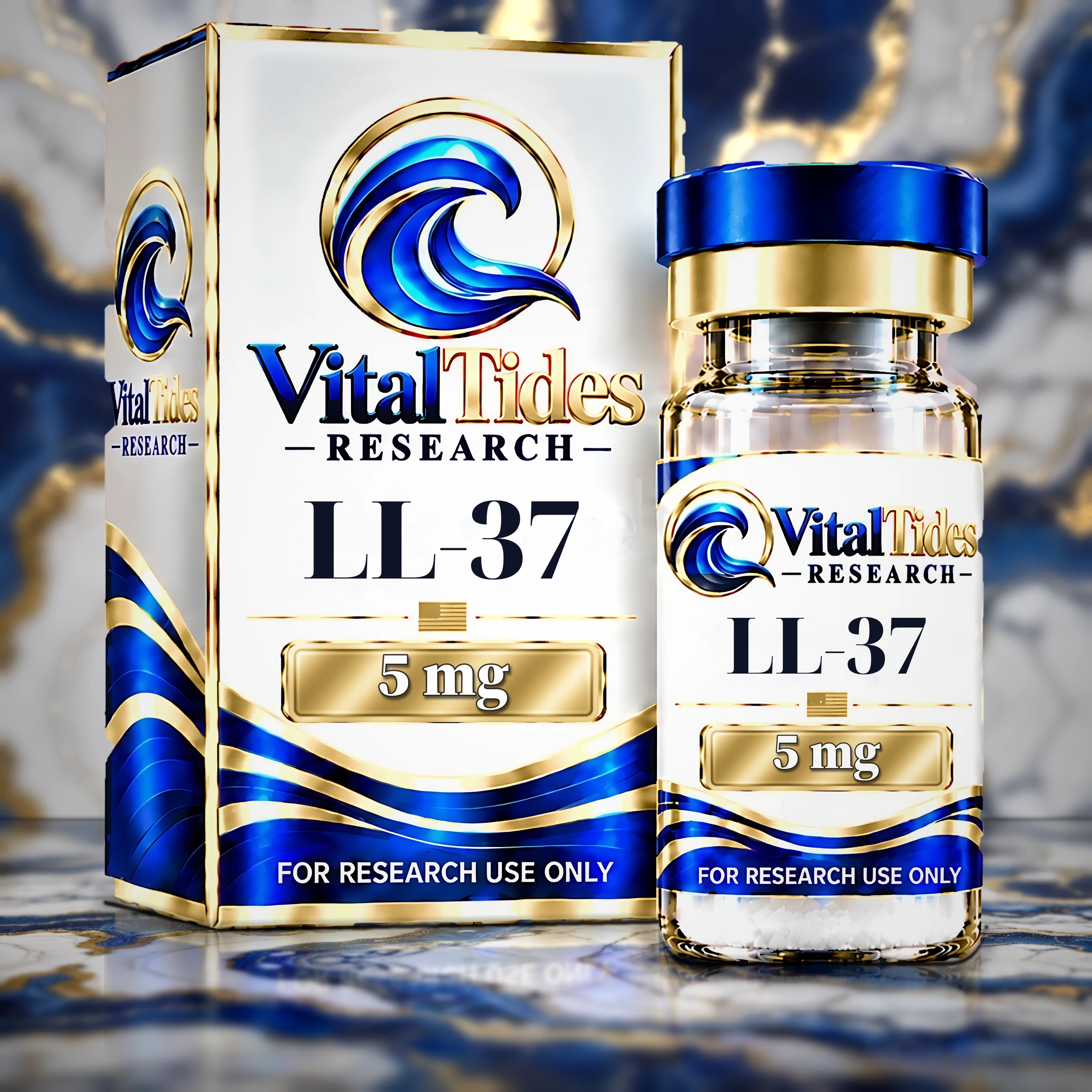
LL-37
$70.00
1000 in stock
The sole human cathelicidin, a 37-residue amphipathic helical peptide studied for membrane-disruptive antimicrobial activity and immunomodulatory signalling. Store at −4 °F (−20 °C).
Description
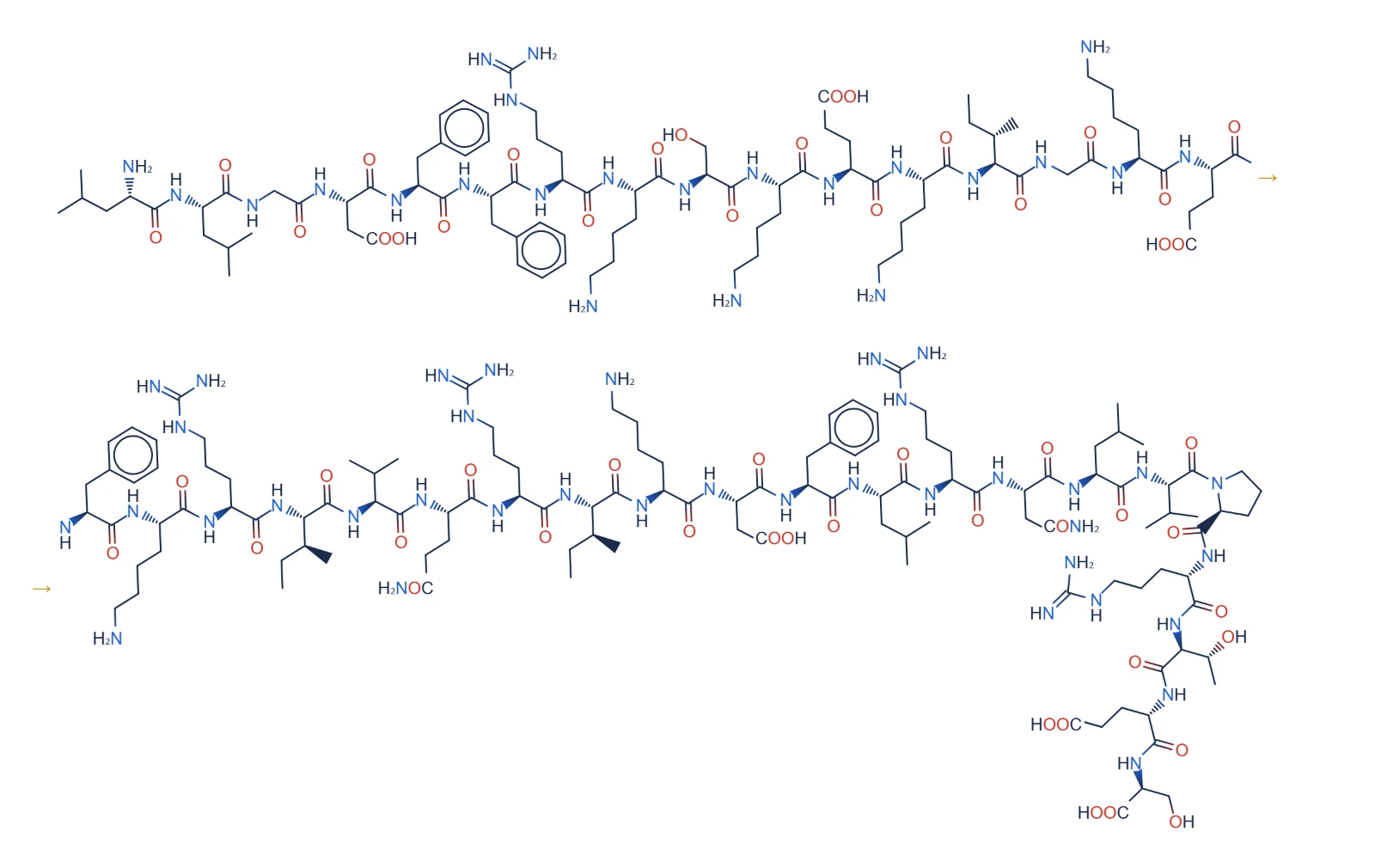
LL-37 is a 37-amino-acid peptide with the sequence LLGDFFRKSKEKIGKEFKRIVQRIKDFLRNLVPRTES and a molecular weight of 4493.26 g/mol. It is the only cathelicidin found in humans, and is also referred to as cathelicidin LL-37 or the CAMP gene product.
Structure
LL-37 is produced as the C-terminal portion of a precursor protein called hCAP18, released by proteolytic cleavage. Its name comes from its first two residues, both leucine, and its length.
The molecule contains no cysteine residues and therefore no disulfide bonds. What governs its behaviour instead is conformation: in solution it adopts an amphipathic alpha-helix, meaning the helix has a hydrophobic face on one side and a cationic face on the other.
That arrangement is the mechanism. The hydrophobic face inserts into lipid membranes while the positively charged face interacts with the negatively charged outer surface characteristic of bacterial membranes. This is why the peptide’s activity is described as membrane-disruptive rather than target-specific, and why resistance to it develops differently from resistance to conventional antibiotics.
Research background
Published work on LL-37 is substantial and spans several areas.
The foundational area concerns antimicrobial activity, with in vitro work against a broad range of bacterial species, and studies examining how membrane composition affects susceptibility.
A second area concerns immunomodulation. Beyond direct membrane effects, LL-37 has been studied as a signalling molecule, with published work examining chemotactic behaviour toward immune cell populations and interaction with receptors on those cells.
A third area concerns wound and barrier models, reflecting the peptide’s expression in epithelial tissue.
A fourth area concerns its role in inflammatory conditions, where published work has examined both protective and pathological associations, making this one of the more nuanced literatures in this catalogue.
No regulatory authority has approved LL-37 for any use. Findings in vitro and in animal models frequently do not translate.
Storage and handling
Store the lyophilized powder at −4 °F (−20 °C), desiccated and protected from light. Note that this is colder than most products in this catalogue, which are stored at 2 to 8 degrees. Allow the vial to reach room temperature before opening.
Use 4493.26 g/mol for molar calculations.
Purity and verification
Each lot is analysed by an independent laboratory, with identity confirmed by mass spectrometry and purity by HPLC. Test scope varies by lot; consult the certificate for the lot you receive.
Additional information
| Vial Size | 5mg |
|---|---|
| Format |
Related products
-

-
-
KPV
Price range: $65.00 through $120.00Quick ViewSelect options This product has multiple variants. The options may be chosen on the product pageKPV
Price range: $65.00 through $120.00
The C-terminal tripeptide of alpha-MSH (Lys-Pro-Val), studied in cell and rodent models of inflammatory signalling without the pigmentary activity of the parent hormone.
-