VIP
$50.00
1000 in stock
A 28-amino-acid neuropeptide of the secretin-glucagon family signalling through VPAC1 and VPAC2 receptors. Human and porcine sequences are identical. Store at −4 °F (−20 °C).
Description
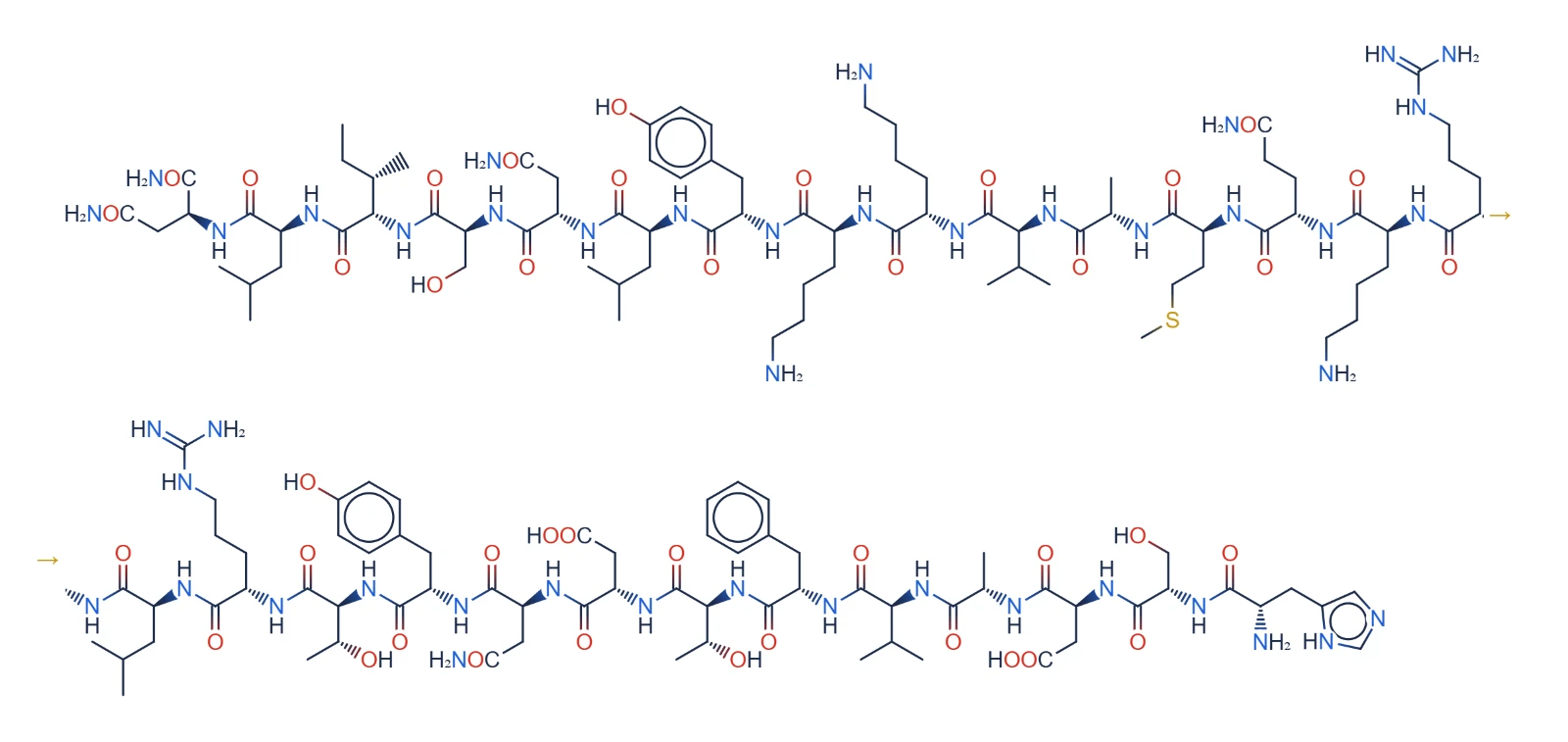
VIP is a 28-amino-acid peptide with a C-terminal amide and a molecular weight of 3325.8 g/mol. Its full name is vasoactive intestinal peptide, and the synthetic form is also known as aviptadil.
Origin and naming
VIP was first isolated from porcine intestine in 1970, which is where both parts of its name come from: it was identified by its vasodilatory activity, in tissue from the gut. The human sequence was subsequently found to be identical to the porcine one, so unlike many peptides there is no species distinction to worry about when sourcing or comparing literature.
Despite the name, VIP is not primarily an intestinal molecule. It is widely distributed in the nervous system and acts as a neurotransmitter and neuromodulator, which accounts for most of the published research interest.
Structure and family
VIP belongs to the secretin-glucagon superfamily, which also contains glucagon, GLP-1, GIP, secretin and growth hormone-releasing hormone. Several members of that family appear elsewhere in this catalogue, and the shared structural lineage is why they engage related class B G-protein-coupled receptors.
VIP signals through two such receptors, VPAC1 and VPAC2. The C-terminal amide is required for activity, which is why the synthetic peptide is supplied amidated rather than with a free acid terminus.
Research background
Published work spans several areas.
The foundational area concerns receptor pharmacology, with in vitro characterisation of binding and activation at VPAC1 and VPAC2, and work on the downstream cyclic AMP signalling those receptors engage.
A second area concerns smooth muscle and vascular tissue, reflecting the activity that gave the peptide its name.
A third area concerns immune signalling, where published work has examined VIP in relation to inflammatory mediator expression in cell systems and rodent models.
A fourth area concerns the central nervous system, including circadian biology, where VIP-expressing neurons in the suprachiasmatic nucleus have been studied extensively for their role in synchronising circadian rhythm.
Under the name aviptadil the peptide has been the subject of human clinical investigation. No regulatory authority has approved it for general use, and the material supplied here is for laboratory research only.
Storage and handling
Store the lyophilized powder at −4 °F (−20 °C), desiccated and protected from light. This is colder than most products in this catalogue. Allow the vial to reach room temperature before opening.
Use 3325.8 g/mol for molar calculations. Note that some supplier listings quote a figure around 3225, which does not match the molecular formula; the formula computes to 3325.8.
Purity and verification
Each lot is analysed by an independent laboratory, with identity confirmed by mass spectrometry and purity by HPLC. Test scope varies by lot; consult the certificate for the lot you receive.
HSDAVFTDNYTRLRKQMAVKKYLNSILN-NH2
Additional information
| Vial Size | 10mg |
|---|---|
| Format |
Related products
-

-
KPV
Price range: $65.00 through $120.00Quick ViewSelect options This product has multiple variants. The options may be chosen on the product pageKPV
Price range: $65.00 through $120.00
The C-terminal tripeptide of alpha-MSH (Lys-Pro-Val), studied in cell and rodent models of inflammatory signalling without the pigmentary activity of the parent hormone.
-

-