
KISSPEPTIN-10
$55.00
995 in stock
The human C-terminal decapeptide of kisspeptin, an upstream regulator of GnRH neurons studied in reproductive endocrinology. Human sequence; the murine analogue differs.
Description
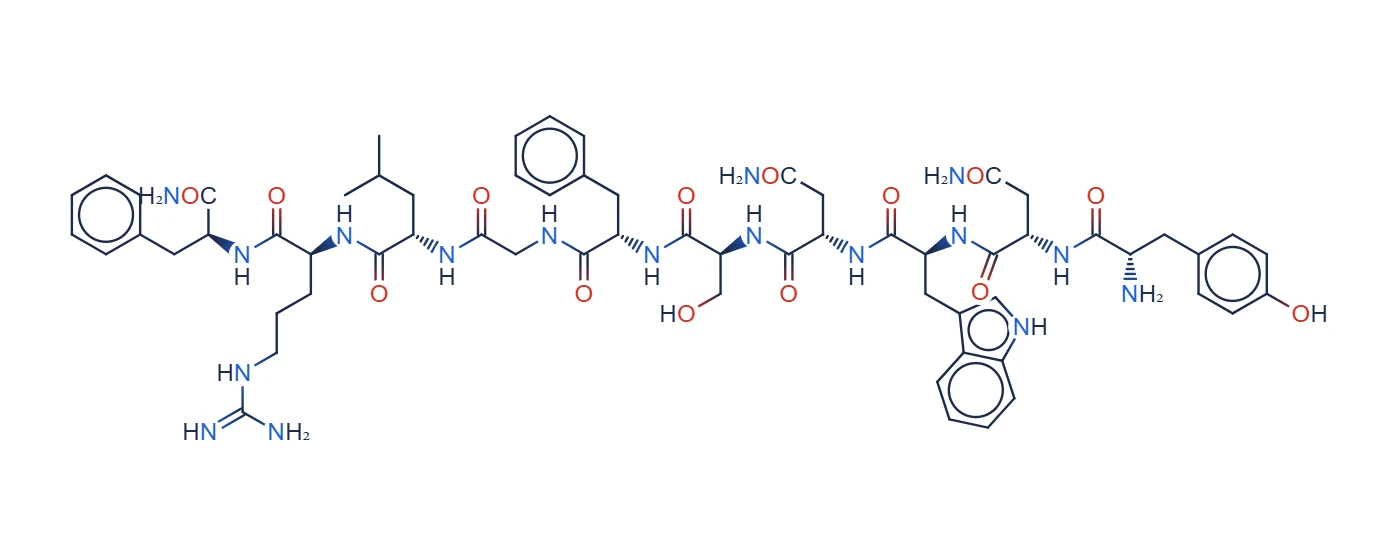
Kisspeptin-10 is a 10-amino-acid peptide with the sequence Tyr-Asn-Trp-Asn-Ser-Phe-Gly-Leu-Arg-Phe-NH₂ and a molecular weight of 1302.45 g/mol. It is the C-terminal decapeptide of the larger kisspeptin protein, and is also written as Kp-10 or metastin (45-54).
Structure and species
Kisspeptins are encoded by the KISS1 gene and processed into peptides of varying length that share a common C-terminal region. Kisspeptin-10 is the shortest of these and retains full receptor activity, which is why it is the form most used in laboratory work rather than the longer variants.
Species matters here more than for most peptides in this catalogue. The human sequence ends in phenylalanine. The murine sequence ends in tyrosine instead, giving a different registry number and a mass of approximately 1318.5 g/mol rather than 1302.45. Vendors commonly list both simply as Kisspeptin-10 with no qualifier. The material supplied here is the human sequence. Researchers working in rodent models should confirm which sequence their experimental design requires, since the two are not interchangeable.
The C-terminal amide is required for activity, as is common in the RFamide peptide family to which kisspeptin belongs.
Research background
Kisspeptin has an unusual research history. The KISS1 gene was originally identified in the context of metastasis suppression, which is the origin of the alternative name metastin. Its role in reproductive endocrinology was discovered subsequently and independently, when mutations in its receptor were linked to disrupted pubertal development.
The principal area of published work now concerns the hypothalamic-pituitary-gonadal axis. Kisspeptin signalling through its receptor, KISS1R, is described as an upstream regulator of gonadotropin-releasing hormone neurons, placing it near the top of that regulatory cascade.
A second area concerns puberty and reproductive timing in animal models.
A third area retains the original oncology thread, with work on metastasis suppression in cell systems.
The peptide has been used in human research settings, but no regulatory authority has approved it for general use. The material supplied here is for laboratory research only.
Storage and handling
Store the lyophilized powder at 36 to 46 °F (2 to 8 °C), desiccated and protected from light. The tryptophan residue makes light protection worthwhile. Allow the vial to reach room temperature before opening.
Use 1302.45 g/mol for the human sequence. If comparing against literature that used the murine peptide, note the 16 dalton difference.
Purity and verification
Each lot is analysed by an independent laboratory, with identity confirmed by mass spectrometry and purity by HPLC. Test scope varies by lot; consult the certificate for the lot you receive.
YNWNSFGLRF-NH2
Additional information
| Vial Size | 10mg |
|---|---|
| Format |
Related products
-

-
-

-
HCG
Price range: $85.00 through $120.00Quick ViewSelect options This product has multiple variants. The options may be chosen on the product pageHCG
Price range: $85.00 through $120.00
HCG – 5000IUmg