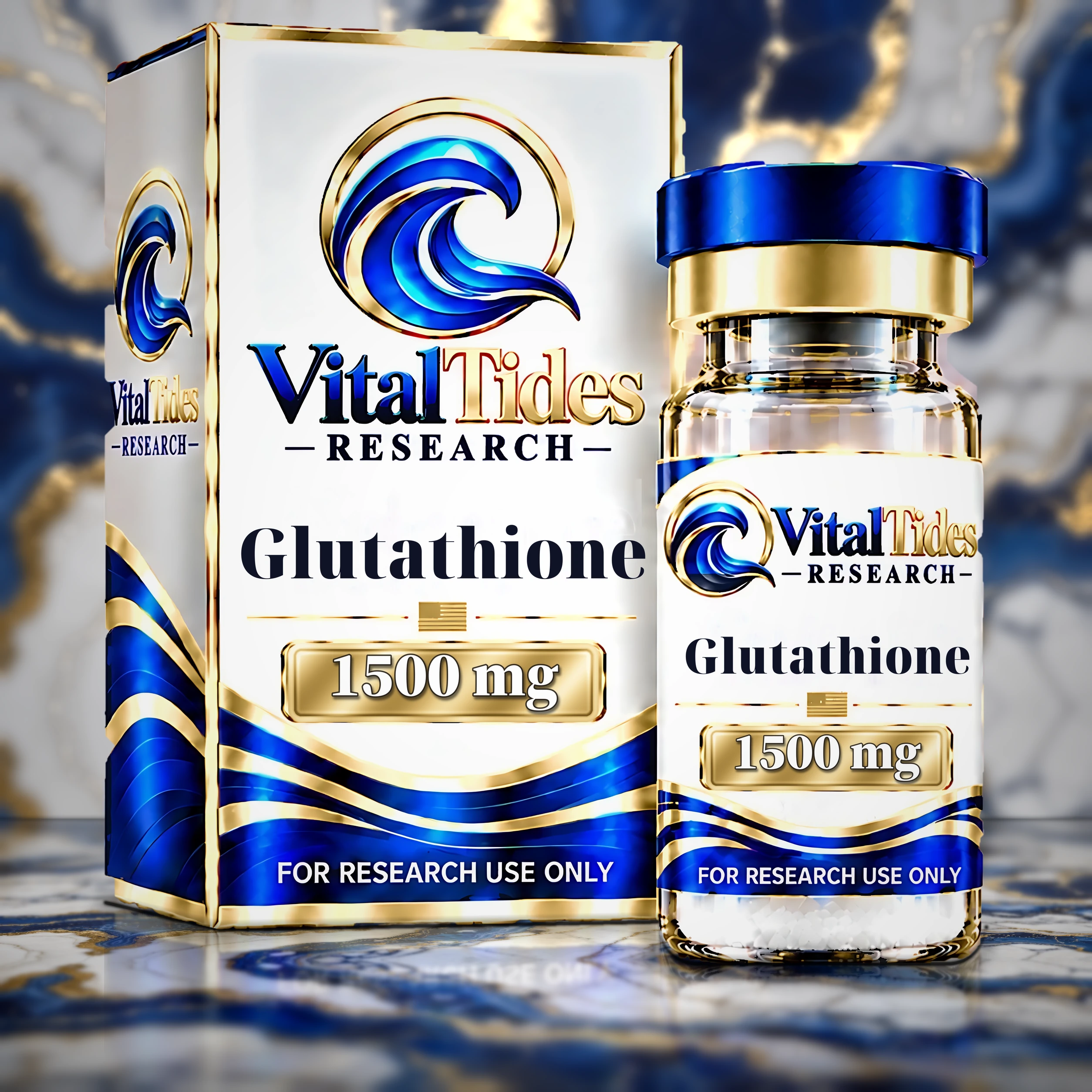
GLUTATHIONE
$55.00
1000 in stock
Reduced glutathione (GSH), a gamma-linked tripeptide central to cellular redox chemistry, peroxide reduction and phase II conjugation. Oxidises readily in air.
Description
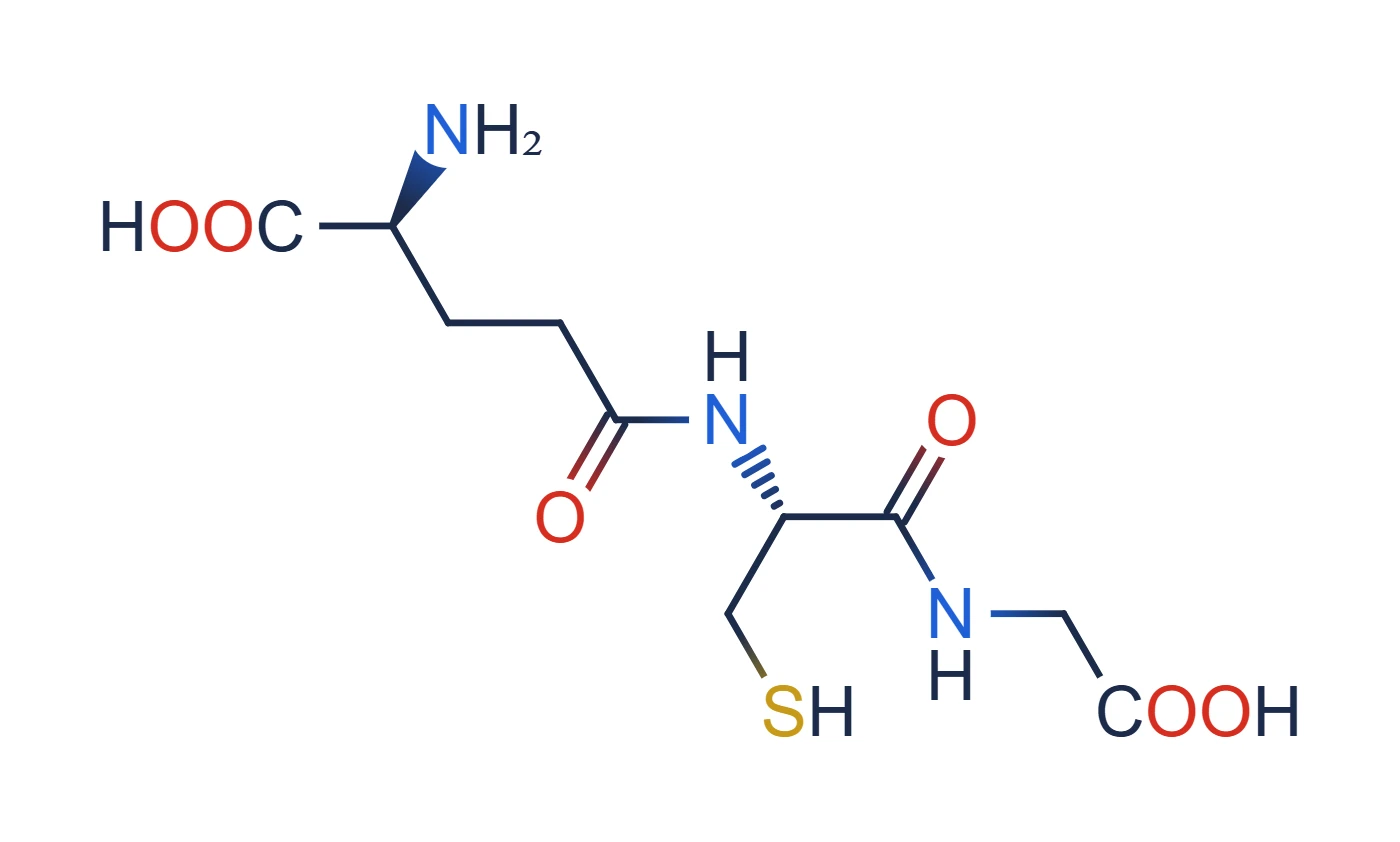
Glutathione is a tripeptide with the sequence gamma-Glu-Cys-Gly and a molecular weight of 307.32 g/mol. It is supplied here in the reduced form, abbreviated GSH, and is among the most abundant small molecules in living cells.
The gamma linkage
Glutathione is not an ordinary peptide, and the difference is worth understanding before working with it.
In a standard peptide bond, the alpha-carboxyl group of one amino acid joins the amino group of the next. In glutathione, the glutamate connects through its side-chain carboxyl instead, forming what is termed an isopeptide or gamma linkage. Writing the sequence as Glu-Cys-Gly, without the gamma, describes a different molecule.
This has a direct functional consequence. Standard aminopeptidases and most proteases cannot cleave a gamma linkage, so glutathione resists the enzymatic degradation that would rapidly dismantle a conventional tripeptide. Its breakdown requires a specific enzyme, gamma-glutamyl transpeptidase. This is why a three-residue molecule can persist at millimolar concentrations inside cells.
Reduced and oxidised forms
The cysteine thiol group is where glutathione’s chemistry happens. Two glutathione molecules can join through a disulfide bond between their cysteines, forming the oxidised dimer GSSG.
GSH and GSSG are distinct compounds with different registry numbers and different masses: 307.32 for the reduced monomer, 612.63 for the oxidised dimer. The material supplied here is the reduced form. The ratio between the two is a standard measure of cellular redox state, so for any redox work, confirming which form you have is essential rather than incidental.
Research background
The literature is enormous and long-established, and glutathione is better described as a subject of basic biochemistry than as an experimental compound.
Core areas include its role as an electron donor in the reduction of peroxides by glutathione peroxidase, its function in phase II conjugation reactions by which cells process xenobiotics, its participation in protein S-glutathionylation as a post-translational modification, and its use as a redox buffer maintaining the intracellular thiol environment.
The GSH to GSSG ratio is widely used as an experimental readout of oxidative stress.
Storage and handling
Store the powder at 36 to 46 °F (2 to 8 °C), protected from light and air. Allow the container to reach room temperature before opening.
Use 307.32 g/mol for molar calculations on the reduced form.
Store solutions cold and protected from light. Avoid repeated freeze-thaw cycles.
Purity and verification
Each lot is analysed by an independent laboratory, with identity confirmed by mass spectrometry and purity by HPLC. Test scope varies by lot; consult the certificate for the lot you receive.
Glutamate is linked through its side-chain carboxyl, not the α-carboxyl
Additional information
| Vial Size | 20ml vial 1500mg |
|---|---|
| Format |
Related products
-
NAD+
Price range: $60.00 through $100.00Quick ViewSelect options This product has multiple variants. The options may be chosen on the product pageNAD+
Price range: $60.00 through $100.00
Oxidised nicotinamide adenine dinucleotide, a dinucleotide coenzyme central to redox metabolism and a consumed substrate for sirtuins, PARPs and CD38. Not a peptide.
-

EPITALON
Price range: $50.00 through $125.00Quick ViewSelect options This product has multiple variants. The options may be chosen on the product pageEPITALON
Price range: $50.00 through $125.00
A synthetic tetrapeptide (Ala-Glu-Asp-Gly) from the Khavinson bioregulator programme, studied in cell-culture work on telomerase activity and in animal models of circadian regulation.
-
SS-31
Price range: $65.00 through $140.00Quick ViewSelect options This product has multiple variants. The options may be chosen on the product pageSS-31
Price range: $65.00 through $140.00
A mitochondria-targeted aromatic-cationic tetrapeptide (elamipretide) that associates with cardiolipin in the inner mitochondrial membrane, studied in models of oxidative stress and ischaemia-reperfusion.
-
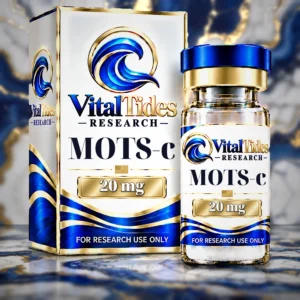
MOTS-C
Price range: $115.00 through $160.00Quick ViewSelect options This product has multiple variants. The options may be chosen on the product pageMOTS-C
Price range: $115.00 through $160.00
A 16-amino-acid mitochondrial-derived peptide encoded within the 12S rRNA gene, studied in preclinical work on AMPK signalling, glucose handling and metabolic regulation.