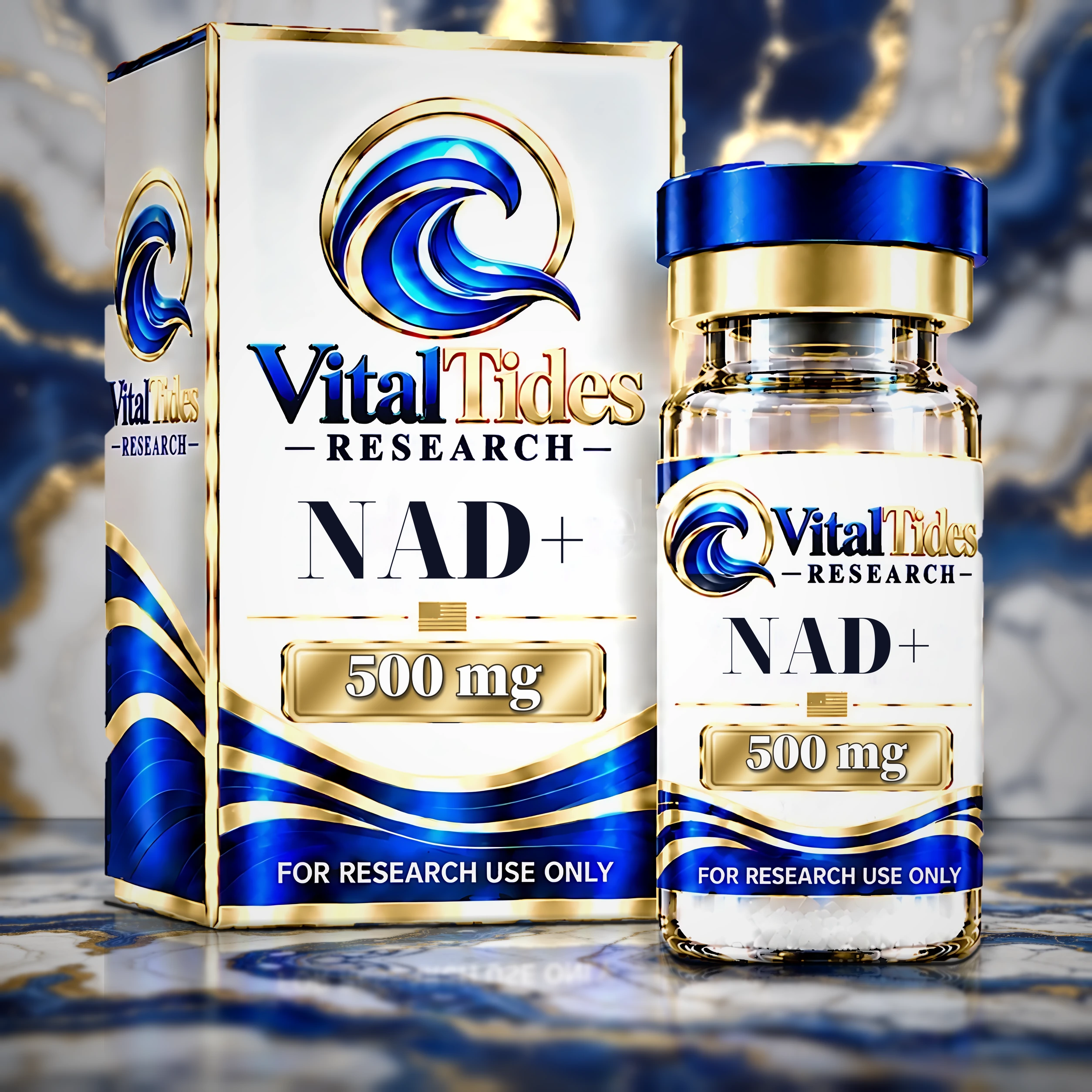
NAD+
Price range: $60.00 through $100.00
Oxidised nicotinamide adenine dinucleotide, a dinucleotide coenzyme central to redox metabolism and a consumed substrate for sirtuins, PARPs and CD38. Not a peptide.
Description
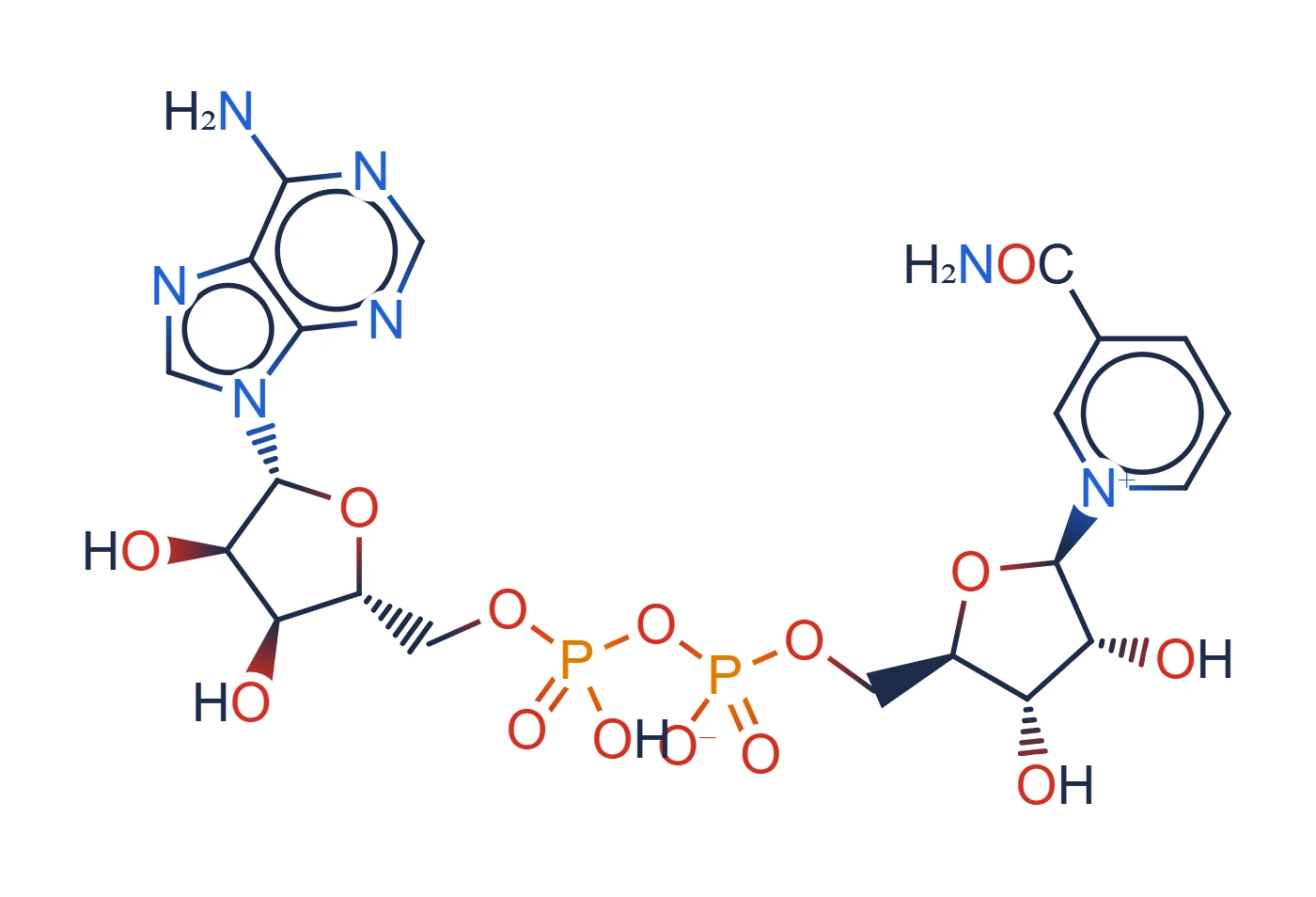
NAD+ is nicotinamide adenine dinucleotide in its oxidised form, with the formula C₂₁H₂₇N₇O₁₄P₂ and a molecular weight of 663.43 g/mol anhydrous. It is also written as beta-NAD or beta-DPN.
Not a peptide
NAD+ sits in a catalogue of peptides but is not one. It is a dinucleotide: two nucleotides joined by a pyrophosphate bridge, specifically nicotinamide riboside 5′-diphosphate linked to adenosine 5′-phosphate. There is no peptide bond in the molecule and no amino acids.
This matters practically. Handling guidance developed for peptides does not transfer directly, and analytical methods differ: NAD+ is quantified by its absorbance at 260 nm from the adenine ring, not by the peptide-bond absorbance used for the rest of this catalogue.
Oxidised and reduced forms
NAD exists in two interconverting forms and they are distinct compounds. NAD+ is the oxidised form at 663.43 g/mol. NADH is the reduced form at 665.44 g/mol, carrying two additional hydrogens.
The material supplied here is the oxidised form. The two are not interchangeable: NAD+ accepts electrons, NADH donates them, and an experiment requiring one will not work with the other. NADH also absorbs strongly at 340 nm where NAD+ does not, which is the basis for the great majority of enzyme assays using this cofactor.
Research background
NAD+ is foundational biochemistry rather than an experimental compound, and the literature is correspondingly vast.
Its classical role is as an electron carrier in central metabolism, accepting electrons in glycolysis and the citric acid cycle and delivering them to the respiratory chain.
A second and more recent area concerns its role as a consumed substrate rather than a recycled carrier. Sirtuins, PARP enzymes and CD38 all cleave NAD+ during their reactions, meaning these enzymes deplete the cellular pool. This consumption relationship is the basis for most current research interest, particularly work examining NAD+ availability in the context of ageing and metabolic regulation.
A third area concerns the biosynthetic and salvage pathways that maintain the cellular pool.
Storage and handling
Store the powder at 36 to 46 °F (2 to 8 °C), desiccated and protected from light. Allow the container to reach room temperature before opening.
NAD+ is hygroscopic and takes up water from the air, which affects weighing accuracy. It is also unstable in alkaline solution, degrading appreciably above neutral pH, while NADH shows the opposite pattern and is unstable in acid. Prepare solutions fresh where possible and keep them cold.
Use 663.43 g/mol for the anhydrous form. Hydrated forms carry additional mass; check your certificate.
Store solutions frozen in single-use aliquots where possible and avoid repeated freeze-thaw cycles.
Purity and verification
Each lot is analysed by an independent laboratory, with identity and purity confirmed by appropriate analytical methods. Test scope varies by lot; consult the certificate for the lot you receive.
Additional information
| Vial Size | 500mg 5ml, 1000mg 10ml |
|---|---|
| Format |
Related products
-
SS-31
Price range: $65.00 through $140.00Quick ViewSelect options This product has multiple variants. The options may be chosen on the product pageSS-31
Price range: $65.00 through $140.00
A mitochondria-targeted aromatic-cationic tetrapeptide (elamipretide) that associates with cardiolipin in the inner mitochondrial membrane, studied in models of oxidative stress and ischaemia-reperfusion.
-
-

EPITALON
Price range: $50.00 through $125.00Quick ViewSelect options This product has multiple variants. The options may be chosen on the product pageEPITALON
Price range: $50.00 through $125.00
A synthetic tetrapeptide (Ala-Glu-Asp-Gly) from the Khavinson bioregulator programme, studied in cell-culture work on telomerase activity and in animal models of circadian regulation.
-
MOTS-C
Price range: $115.00 through $160.00Quick ViewSelect options This product has multiple variants. The options may be chosen on the product pageMOTS-C
Price range: $115.00 through $160.00
A 16-amino-acid mitochondrial-derived peptide encoded within the 12S rRNA gene, studied in preclinical work on AMPK signalling, glucose handling and metabolic regulation.